
What’s the deal with all these juvenile humanoids?
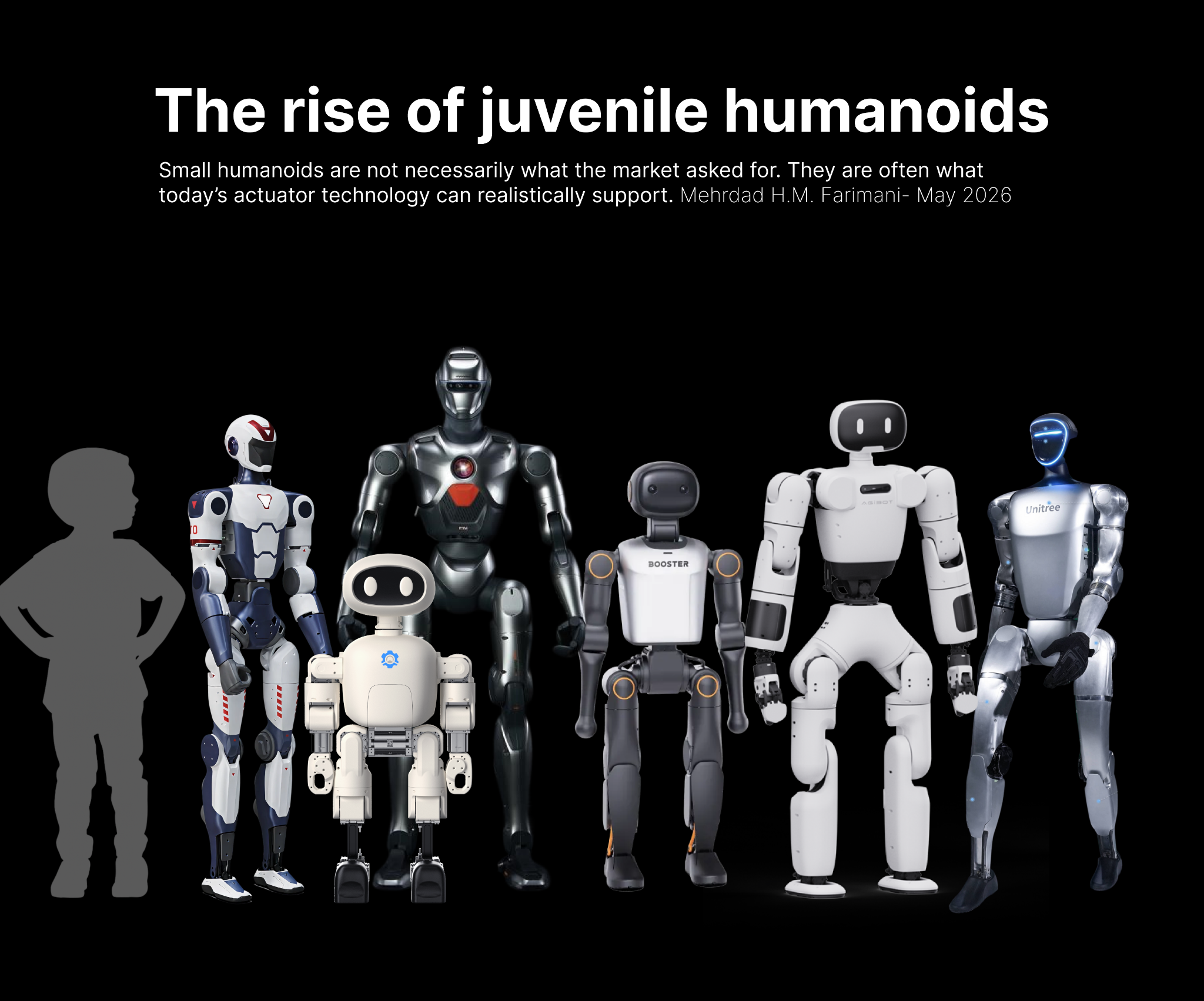
Small humanoids are not necessarily what the market asked for. They are often what today’s actuator technology can realistically support.
I have been thinking a lot about the recent wave of small humanoid robots.
Not childlike robots designed for children. Not entertainment robots. Not toys. I mean the growing category of 120 to 140 cm humanoids that look like compressed versions of the future we are being promised.
And honestly, I think their best use case today is research.
Research, education, algorithm development, demos, maybe dancing. They are very useful platforms for labs, developers, and companies trying to train locomotion, imitation learning, teleoperation, whole-body control, and human-robot interaction. But as general-purpose humanoids for the real world? I am not convinced.
There are exceptions, of course. If the robot is intentionally designed for children, schools, entertainment, competitions, or controlled research environments, then a smaller body makes complete sense. In those contexts, small size is not a weakness. It is the product requirement.
But that is not the same thing as saying this is the right form factor for the humanoid future.
Because the humanoid promise is usually built around the human environment. Human-sized doors. Human-height shelves. Human workstations. Human tools. Human data. Human demonstrations. Human interaction distance. Human reach.
If that is the premise, then the target body should be roughly human scale. Maybe not exactly 175 cm, but close enough to share our proportions, reach envelopes, manipulation heights, and motion data. A 120 cm humanoid does not really check those boxes.
So my second claim is this:
Many of these small humanoids are not small because the world needs small humanoids. They are small because today’s hardware makes small humanoids much easier to build.
That does not make them bad. It makes them transitional.
The mechanical reason is fairly simple. When you make the robot taller, you do not just stretch the limbs. You increase mass, lever arms, inertia, fall energy, actuator load, battery demand, thermal load, and structural stiffness requirements at the same time.
The joint does not care about our market narrative. It only sees torque.
A knee or hip actuator has to move body mass through a lever arm. If the robot gets taller and heavier, the required torque grows fast. In a simplified geometric scaling model, mass grows with the cube of size, while limb length grows linearly. That means joint torque can grow roughly with the fourth power of scale. Real robots do not follow that perfectly, but the direction is brutal.
This is where QDD actuators become important.
Quasi-direct-drive actuators are great for dynamic robots because they use relatively low gear ratios, which helps with backdrivability, torque transparency, lower reflected inertia, and better physical interaction. But low gearing also means you cannot hide behind a giant gearbox. You need more motor current, more thermal capacity, more magnetic material, more structure, or more actuator mass. The tradeoff becomes very visible at humanoid scale. A robotics actuation workshop from the University of Twente describes this exact tension: lower gearing improves interaction qualities, but creates challenges around current, heating, torque capacity, and torque density, which is why many QDD applications have stayed in smaller robots.
That is why the 120 to 140 cm range is so interesting.
It is not random. It is a sweet spot.
At that size, the robot is large enough to look humanoid, walk dynamically, carry sensors, host onboard compute, and run useful learning experiments. But it is still small enough that available compact actuators can survive the torque, heat, mass, and cost envelope.
Look at the pattern. Unitree G1 is 132 cm tall, around 35 kg, with 90 to 120 Nm maximum knee torque depending on configuration. Booster T1 is 118 cm tall, around 30 kg, and is explicitly positioned as “made for developers.” ROBOTIS K0 is 130 cm and 34 kg, with ROBOTIS describing its DYNAMIXEL-Q actuators as QDD units designed for backdrivability, low impedance, and precise torque control.
Then compare that to a more human-sized platform like Fourier GR-1: 165 cm, 55 kg, 44 joints, and up to 230 Nm peak torque. The height difference does not look huge on paper. But mechanically, it changes everything.
So when I see these smaller humanoids, I do not see the final product. I see the current actuator envelope made visible.
Small humanoids reduce the punishment. They fall with less energy. They are easier to ship, easier to test, easier to repair, safer in a lab, and cheaper to iterate. Stanford’s ToddlerBot project makes a similar argument for research platforms: smaller humanoids are low-cost, open-source platforms for scalable policy learning and AI research.
That is the real value.
But I think we should be honest about what they are.
They are not necessarily proof that the humanoid market wants juvenile bodies. They are proof that current robotics hardware, especially compact QDD-style actuation, becomes much more practical when the robot is shorter, lighter, and less mechanically demanding.
This is why I think many of these robots will either stay in research and education, or evolve into larger, more application-specific systems. The small ones may survive in niches: schools, labs, entertainment, competitions, child-facing interaction, teleoperation research, and low-risk data collection.
But for factories, homes, logistics, eldercare, maintenance, and general human-environment work, the pressure will keep pushing the body back toward human scale.
Because the whole argument for humanoids is not that they have two legs and a head.
The argument is that they can operate in a world built around us.
And if they are too small to reach that world, then they are not really solving the humanoid problem yet. They are helping us learn how to solve it.
Cheers
