
The Highest Form of Robot Acceptance Is Being Ignored
My latest trip to Japan opened my eyes to something I have been thinking about for years: culture is not a side topic in robotics. It is infrastructure.
This text is not a research paper. It is an observation, mixed with years of working around robotics, designing robots, meeting robotics companies, and watching this strange industry try to grow up.
You do not see robots everywhere in Japan. That is not the point. In fact, if you go there expecting a Blade Runner city full of machines, you will probably be disappointed. The interesting part is more subtle. You feel that people have a sense of proximity to robots. They do not necessarily see them as magic. They also do not immediately see them as monsters.
They see them as helpers, companions, tools, characters, contributors. Sometimes useful. Sometimes cute. Sometimes useless but emotionally meaningful. And that is a very different starting point.
You can see part of this in pop culture. Japanese anime has given robots many roles: friends, protectors, children, spirits, machines with personality, machines with purpose. American science fiction, on the other hand, has often given us robots as threats, warnings, predators, replacements, or things that eventually need to be controlled by a brave human.
Of course this is a simplification. There are friendly robots in the West and terrifying robots in Japan. But the cultural default matters. Because the first question a society asks about robots shapes what kind of robots it allows to exist.
In some places, robots are seen mainly as productivity tools. They belong in factories, warehouses, farms, ports, mines. They should do the dirty, dangerous, boring work, and stay away from the soft parts of life. This might be the more European industrial view.
In some places, robots are imagined as powerful but dangerous creatures. They are impressive, but they need to be tamed, regulated, contained, beaten, or outsmarted by humans. This is perhaps closer to the American myth.
In some places, robots are symbols of national progress. They are proof that a country is modern, ambitious, technically capable. They are shown on stages, at exhibitions, in videos, as a signal that the future has arrived. But that does not always mean people actually want to live with them.
And then there is Japan.
Japan should not be romanticized. It is not a robot paradise. Many robots still fail there, as they fail everywhere else. Many demos are still demos. Many use cases are still fragile. But what feels different is that robots seem to have a more natural cultural permission to be explored.
That permission matters more than we think.
Robotics is not like smartphones or cars. With a car, the need is obvious: move people from A to B. With a phone, the need is obvious: connect people to people, information, and services. The value chain is clear. The product category is clear. The desire is clear.
Robotics is different.
We know we need robots. We need them because societies are aging. We need them because labor is becoming harder to find. We need them because some jobs are unsafe, repetitive, physically damaging, or simply unattractive. We need them because human life should not be spent on every task that can be automated.
But knowing that we need robots does not immediately tell us what robot to build.
The path from need to product in robotics is non-linear. It is messy. It starts with a vague feeling, not always a clear specification. A robot can be a worker, a pet, a tool, a presence, a toy, a character, a machine, a companion, a platform, or a service. Sometimes the technical value is obvious. Sometimes the emotional value comes first. Sometimes the robot makes sense only after people have lived with it.
This is why culture matters.
A culture that accepts robots gives robotics companies more room to search. More room to test. More room to fail in public without becoming a joke. More room to create strange products that do not fit the usual business case on day one. More room to discover where robots actually belong.
That might be one of the biggest advantages Japan has.
During my trip, I visited Shunsuke Aoki’s studio at Yukai Engineering. They have been designing and building companion robots and emotionally driven devices for more than a decade, including products like Qoobo, BOCCO, Amagami Ham Ham, and Nekojita FuFu.
What stood out to me was not only the products. It was the process.
Shunsuke explained that their ideation can start by asking everyone in the company for ideas, not only designers or engineers. The accountant can have an idea. Sales can have an idea. Anyone can suggest what a robot could be.
To me, this says something important.
It means the robot is not treated only as a technical object. It is treated as an experience object. Something that belongs to everyday life. Something that can be imagined by people outside the engineering room.
In many Western robotics companies, ideation still happens in closed rooms. A few founders, engineers, product leads, or investors define the use case. The robot is born from a strategy deck, a technical roadmap, or a market opportunity. Then it is pushed toward users.
But maybe robots should sometimes be pulled from culture instead.
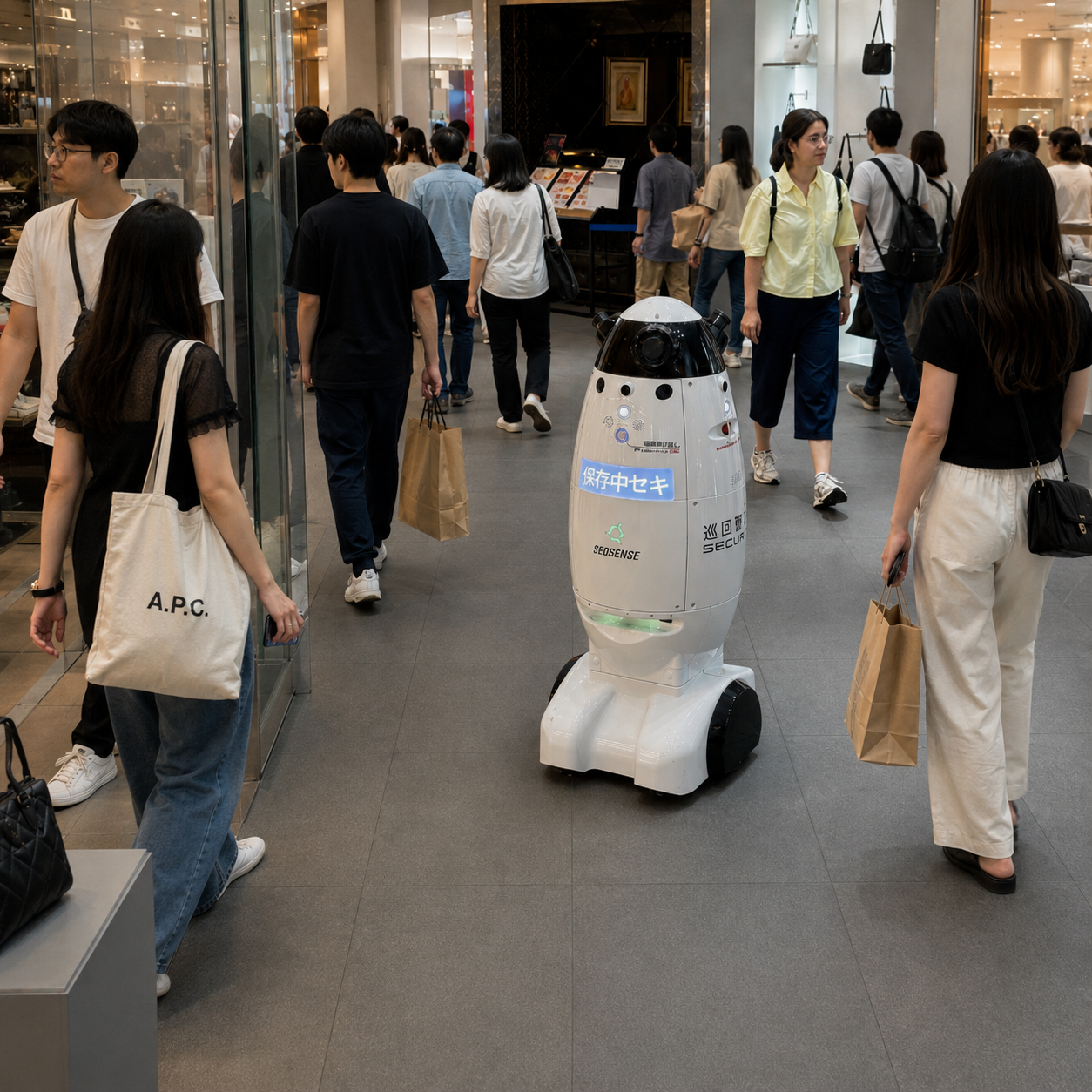
Another moment stayed with me. In some department stores, I saw security robots moving around. They were not perfect. They were not dramatic. They were not treated as celebrities. Most people ignored them. No one seemed shocked. No one was gathering around to take photos, except tourists like me.
That small detail says a lot.
The highest level of robot acceptance is not applause. It is indifference.
When a robot can move through a public space without becoming an event, that means society has made room for it. It has become part of the background. It has permission to exist.
This does not happen overnight. Japan has been building the idea of humanoids for a long time. Waseda started the WABOT project in 1970, and WABOT-1 was completed in 1973. Long before many of us in the West made The Terminator our default image of a robot, Japan was already experimenting with machines that could walk, communicate, and imitate parts of human behavior.
That history matters. Not because old robots were commercially useful, but because they created cultural memory.
When a country has seen robots as characters, helpers, factory workers, research platforms, toys, companions, and national projects for decades, the public imagination becomes more flexible. People can hold more than one version of the robot in their mind.
This flexibility is essential for the next stage of robotics.
Because humanoids are coming back now with a huge amount of hype. Every company wants a piece of the movement. Every investor wants to know who will build the next general-purpose robot. Every nation wants to show that it can compete.
But the real question is not only who can build robots.
The real question is: who can live with them?
A society can buy robots without accepting them. A company can deploy robots without understanding them. A nation can celebrate robots on stage while rejecting them in everyday life. This is where many robotics efforts collapse. They treat adoption as a technical or economic problem, when it is also a cultural problem.
Robots need tasks, yes. They need batteries, actuators, perception, manipulation, safety systems, service models, maintenance plans, and regulatory frameworks.
But they also need stories.
Not fake marketing stories. Cultural stories. Shared stories about what robots are allowed to be. Are they workers? Are they servants? Are they companions? Are they dangerous? Are they childish? Are they spiritual? Are they embarrassing? Are they status symbols? Are they part of the family? Are they tools? Are they alive enough to care about, or dead enough to ignore?
These questions sound philosophical, but they become product requirements.
If people see robots only as threats, they will demand one kind of design.
If people see robots only as productivity machines, they will accept only another kind.
If people see robots as social objects, the design space becomes much wider.
This is why I believe culture can either enable or delay robotics.
The robotics industry often talks about hardware bottlenecks, AI bottlenecks, cost bottlenecks, supply chain bottlenecks. All of these are real. But maybe one of the biggest bottlenecks is cultural imagination.
We do not only need better robots.
We need better ways of imagining robots.
Japan is not a model to copy blindly. No culture should be copied like software. But there is something to learn from the way robots are allowed to be strange there. Allowed to be cute. Allowed to be emotional. Allowed to be imperfect. Allowed to be present before they are fully optimized.
That matters because early robots will not be perfect. They will be slow, limited, awkward, expensive, and sometimes ridiculous. If society only accepts robots when they are fully useful, then we may never give them enough time to become useful.
The early phase of robotics requires patience. It requires a culture that can tolerate ambiguity. A culture that can say: this is not replacing humans yet, this is not saving the world yet, this is not perfect yet, but maybe it belongs here in some form.
That is the mindset robotics needs.
Not blind optimism. Not hype. Not fear. Not worship.
Just enough cultural openness to let robots find their place.
So perhaps what we need to import from Japan is not the robots themselves. It is not only the hardware, the characters, the aesthetics, or the cute companion devices.
What we need to import is the culture of living with robots.
The same way we imported anime, matcha, sushi, minimalism, and many other parts of Japanese culture, maybe we also need to import a more generous imagination around machines.
Because a culture that accepts robots does not just consume robotics.
It enables robotics.
Cheers
