
Gen-AI Is Great at “A Thing”. Useless for “The Thing”
Something is being misunderstood about CAD Gen AI.
Not just slightly. Fundamentally.
Recently, people have been sending me demos of Cloud Opus 4.7 making shiny CAD models. I appreciate it, really. It’s interesting to watch these tools evolve.
But I think most of these are being evaluated at the wrong level.
There’s a foundational issue with Gen AI. I assumed it was obvious, but apparently not.
Here’s how I look at it.
I’m talking about image, video, and now CAD generators.
If you ask AI to generate an image or a CAD model of a chair, it will probably do it better than most people.
If you ask it to simulate a bicycle, you might get something useful and save time.
If you ask it to design a case for a Raspberry Pi, it might do an okay job. Just review it.
Same in software. A generic restaurant app with booking and menu? AI is very good at that.
Your actual product idea? That’s a different story.
Now I can already hear it:
“You haven’t tried the latest update from X.”
Maybe. But this is not about versions. There are principles here.
These systems are probabilistic. They generate what is statistically likely based on what they’ve seen.
So naturally, they do well on things that are:
common
repeated
well represented in data
And they struggle with things that are:
specific
novel
constraint-heavy
That’s not a temporary limitation. That’s how they work.
Let me ask you something.
When was the last time you needed the design of “a” chair?
Design and engineering is not about “a(n)”.
It’s about “the”.
The chair that fits a specific process.
The bicycle that works for a particular use case and cost.
The enclosure that actually satisfies thermal, structural, and assembly constraints at the same time.
That’s where things change.
Some outputs are easy for Gen AI because the data is clean and abundant. And honestly, nobody cares about those. There are already thousands of them online.
Other things are harder because the data is messy, incomplete, or just wrong.
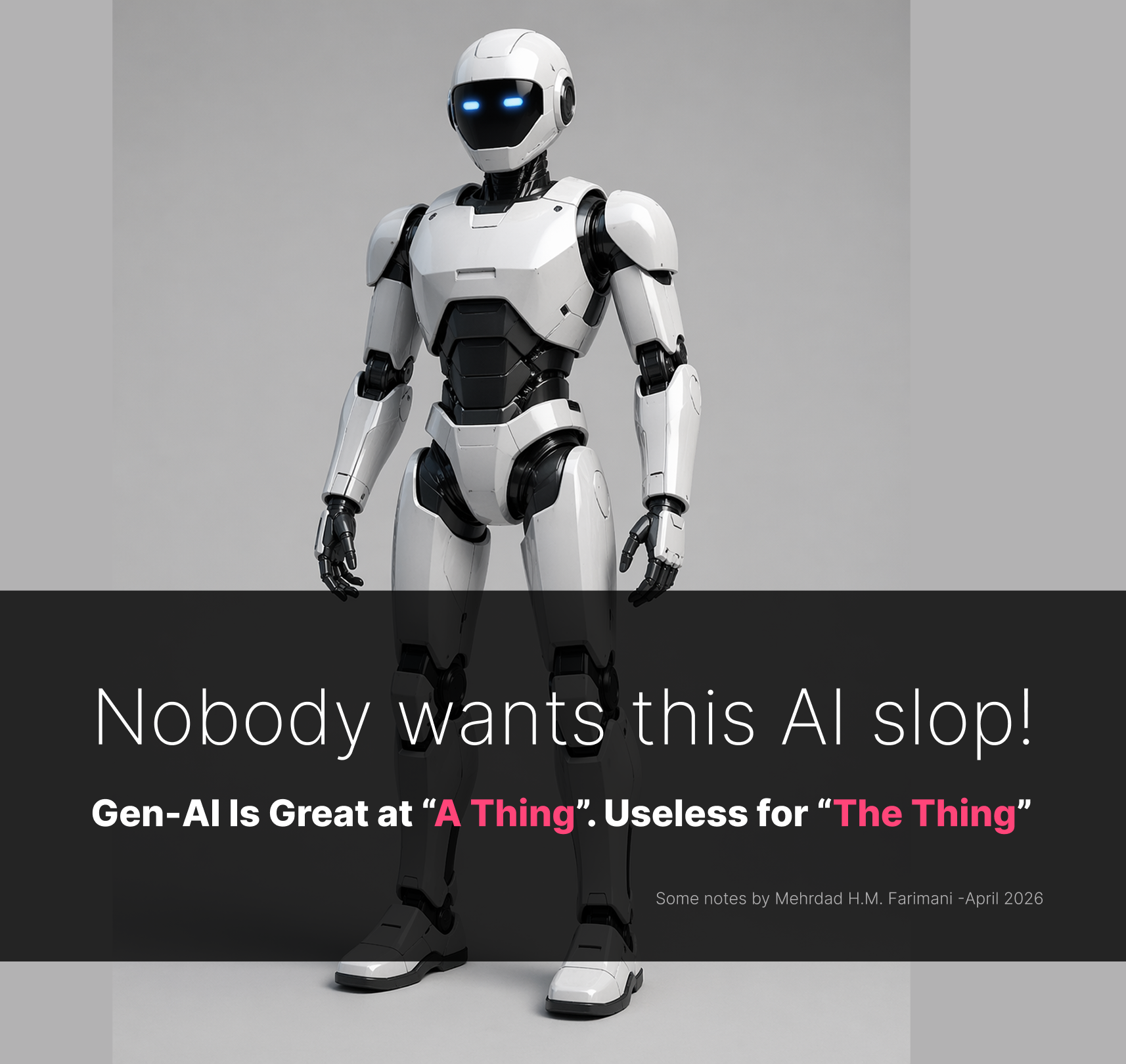
Ask AI to design a humanoid robot.
You’ll get something that looks familiar. Something from a movie, a game, or at best something close to NAO or ASIMO.
It looks right.
But it’s not solving the real problem.
No actuation logic, no balance strategy, no sense of energy, maintenance, or manufacturing. Just a visual confirmation of what people think a humanoid is.
But a real humanoid is not that.
Working in the humanoid space, I realized something very quickly.
You need to create novel concepts across multiple layers.
There’s nothing generic, nothing well-established, nothing you can just copy. It’s all new.
So AI can only help you so much.
And this is the key point.
As a creator, you’re not trying to make “a thing”.
You’re trying to make “the thing”.
The value is in resolving constraints.
The value is in specificity.
A system that is biased toward the statistical average will help you explore, but it won’t carry you all the way there.
Of course, these systems are useful.
They’re great for:
exploring ideas
generating variations
speeding up low-stakes work
I used AI to proofread this text.
I didn’t use it to write it.
Now, going back to CAD.
CAD is not just geometry. It’s one of the most constraint-heavy mediums we have.
You’re dealing with 3D space, but also with manufacturing, materials, cost, assembly, environment, and design decisions all interacting with each other.
Small changes propagate.
Expecting that you can prompt all of this into existence reliably is, at least today, unrealistic.
I like the direction. I want more automation in CAD.
But most of what I see right now, even from the best AI companies, is still surface-level. It looks right, but that’s not the same as being right.
My advice is simple.
If you want to test these systems, don’t ask them to generate the first object you see on your desk.
Give them something specific.
Give them constraints.
Give them trade-offs.
That’s where you’ll see what’s actually going on.
And since I always end up here, robotics.
Most robotic grippers can pick up a cup of coffee. Especially if it’s empty.
But going from picking up a cup
to peeling an orange
is not a small step.
That’s years of work, and a completely different level of complexity.
That gap is exactly what people are underestimating here.
