
Why convergence in design might tell us more about the industry than impressive demonstrations.
Estimated reading time: 8 minutes
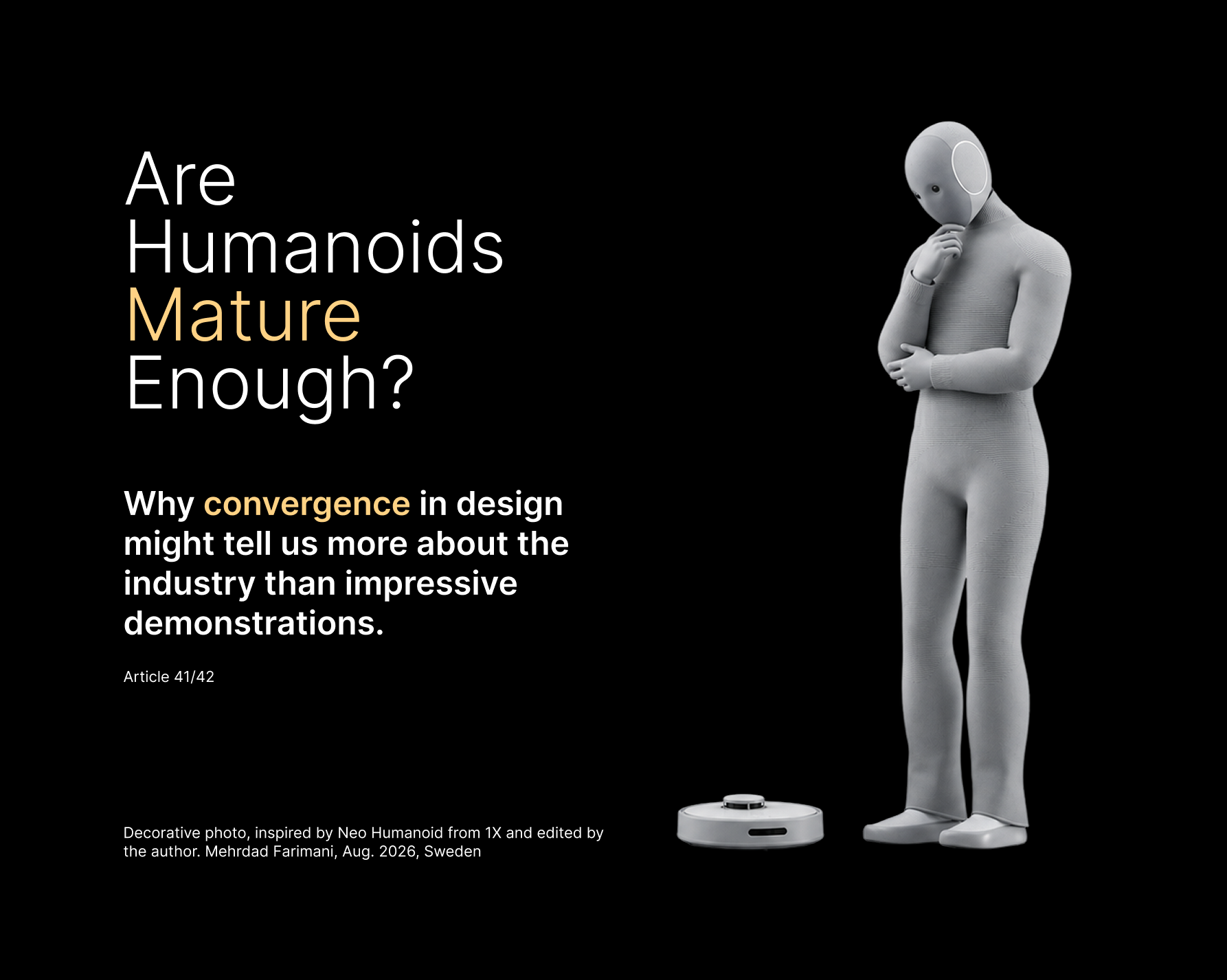
There is a tendency in our industry to romanticize humanoid robots. We often talk about them as if they're some entirely new form of technology, a new species, or perhaps the beginning of a fundamental transformation in human civilization.
Maybe they will eventually become something that important. But from my perspective, at least for now, humanoids are products!
They are complex electromechanical products, but still products. They have customers, suppliers, production costs, maintenance requirements, and hopefully some economic value. What differentiates them from conventional products is mainly the level of versatility they promise, the environments in which they can operate, and the degree of autonomy they can achieve.
Whether they're sold as consumer products, B2B equipment, or offered through a Robot-as-a-Service (RaaS) model, none of this changes their fundamental nature.
And because they're products, I think we can learn quite a lot about their maturity by looking at how other product categories have evolved.
One pattern that has interested me for years is how products tend to become increasingly similar as their industries mature.
Not necessarily in their appearance, but in their underlying architecture.
I actually touched on this in my earlier article, Standardization in Design: Are We There Yet?, published in 2025. After working on several more generations of humanoids, I think this question has become even more relevant.
Why do mature products start looking alike?
Remember the Nokia era?
Mobile phones came in almost every imaginable configuration. Flip phones, sliding keyboards, rotating displays, physical buttons, strange proportions, and some genuinely creative interaction concepts.
Manufacturers were exploring what a mobile phone should actually be.
Today, despite enormous differences in performance, pricing, materials, and brands, the overwhelming majority of smartphones share essentially the same high-level architecture.
A rectangular device, a large touchscreen, a battery, cameras, wireless communication, and an operating system built around relatively familiar interaction principles.
There is still innovation, of course. Foldable devices, different camera arrangements, new sensors, and increasingly sophisticated processors. But most of that innovation happens within an established product architecture, rather than constantly reinventing the product category.
Something similar happened in automotive, although over a much longer period.
Car manufacturers still compete heavily on performance, comfort, styling, safety, and manufacturing technologies. Electric vehicles have also introduced significant architectural changes.
But the underlying principles of passenger vehicles have become relatively well established. Steering, braking, suspension, occupant packaging, safety structures, and vehicle dynamics follow broadly familiar engineering architectures.
The important distinction is that high-level architectural convergence does not mean low-level technical uniformity.
In fact, once the architecture becomes more established, companies can concentrate their resources on optimizing the details.
Why does this happen?
I think there are several interconnected forces.
First, companies gradually discover which engineering solutions work reliably and economically.
Second, customers develop expectations about how a product should behave.
Third, suppliers become specialized around certain components and manufacturing processes. Producing millions of relatively standardized components is usually more economically attractive than producing small quantities of hundreds of completely different designs.
Finally, regulations, industry standards, and competitive pressure start shaping the product itself.
Eventually, the industry develops something like a collective understanding of what the product should be.
This doesn't mean innovation stops.
It means the industry is no longer experimenting with every fundamental assumption simultaneously.
Perhaps robot vacuum cleaners are a better example
A closer comparison to humanoids, at least from a product development perspective, is the robotic vacuum cleaner.
This is a category that has gone through decades of development and has achieved significant commercial adoption. According to iRobot's historical figures, the company alone had sold more than 40 million home robots globally by 2021.
A few years ago, I was involved in a project related to robotic vacuum cleaners, and I learned several interesting things about this industry.
Perhaps the most obvious one is that most successful products share a remarkably similar overall form factor.
They're relatively low, compact, and commonly circular.
This is not a coincidence.
A circular platform has several advantages for indoor navigation. It simplifies the relationship between the robot's footprint and its rotational movement, reduces some collision and clearance problems, and allows relatively predictable behavior around furniture and obstacles.
Of course, circular designs are not the only technically viable solutions.
Neato explored D-shaped products, Dyson has developed several unconventional configurations, and other companies have experimented with different footprints.
These alternatives can offer advantages, particularly around corners, edge cleaning, and brush packaging. So I wouldn't claim that noncircular robots have categorically failed.
But circular platforms have clearly become the dominant design direction.
The same pattern appears in several subsystems.
Differential-drive configurations, commonly using two independently driven wheels with passive support, are widespread. Navigation often combines LiDAR or camera-based mapping with additional proximity and obstacle-detection sensors.
There is no single agreed sensor architecture. Some manufacturers depend heavily on LiDAR, others on cameras, and many combine several sensing technologies.
But despite these differences, we can identify an increasingly familiar product architecture.
Perhaps more importantly, the commercial proposition is also relatively clear.
Customers know what the product does, manufacturers know which performance metrics matter, and suppliers have built an ecosystem around the category.
Cleaning coverage, runtime, suction, navigation reliability, obstacle avoidance, maintenance, and price can all be evaluated against established alternatives.
The industry is far from perfect, and robots still get stuck under furniture. But the fundamental product question is no longer particularly mysterious.
We know what a robotic vacuum cleaner is supposed to do.
Now compare this with humanoids.
Humanoids have two different convergence problems
In my previous article, Robotics Complexity vs Versatility: Why Robots Are Converging, I discussed how modern robotics is gradually combining capabilities that historically existed in separate machines.
Manipulation, mobility, grasping, perception, and autonomy are increasingly becoming integrated into single robotic platforms.
I described this as a movement from specialized, divergent robotic systems toward more versatile, convergent machines.
But there is another type of convergence that I think deserves attention.
Convergence of capabilities is not the same as convergence of product architecture.
The first describes what robots are becoming capable of doing.
The second describes how the industry is learning to build them.
And I suspect humanoid robotics is progressing considerably faster in the first direction than the second.
We can already see some architectural similarities between modern humanoids.
Most full-body platforms have two arms, a torso, an articulated lower body, and some form of head-mounted perception system.
Electric actuation has become increasingly prominent. Many platforms share familiar joint arrangements, comparable proportions, integrated battery systems, and similar approaches to distributed control.
However, once we examine these machines a little more closely, the differences become enormous.
Consider just a few examples.
1. Morphology and locomotion
We still don't agree on how human a humanoid should actually be.
In What Is a Humanoid, and at What Point Does It Stop Being One?, I discussed this extensively.
Does a humanoid need two legs? Are wheels sufficient if the upper body provides human-compatible manipulation? Could wheels integrated into a biped's feet offer a better compromise?
Even within bipedal systems, we have different approaches to feet, ankles, knees, torso articulation, and overall body proportions.
The human body provides a reference architecture, but it doesn't necessarily provide the optimal engineering solution.
2. Actuation and mechanical architecture
This is another fascinating area.
We have relatively conventional rotary actuators, quasi-direct-drive systems, harmonic and planetary transmissions, tendon-driven mechanisms, linear actuators, and various combinations of these.
Even the arrangement of three rotational axes at a humanoid's hip remains an engineering discussion.
YRP, RPY, RYP, and other configurations can significantly influence packaging, motion range, mechanical loading, and structural complexity.
This is something I've seen Scott Walter discuss as well.
And that's just the hip!
We haven't even started discussing hands, where the differences in actuation, sensing, transmission, and kinematics are arguably even greater.
I would not expect all manufacturers to eventually adopt identical mechanisms. Different requirements justify different solutions.
But I would expect certain configurations to become increasingly dominant within specific application categories.
3. Human-robot interaction and physical design
Should the robot have a realistic face, a screen, a simple head with cameras, or no recognizable face at all?
Should it have rigid covers, soft external structures, artificial skin, or exposed mechanisms?
In The Wrong Way to Design a Humanoid, I argued that we should copy the interface between humans and their environment, not necessarily the biological implementation underneath.
This distinction becomes especially important here.
The industry might eventually agree that humanoids need certain human-compatible dimensions, reach envelopes, contact properties, and interaction behaviors without ever agreeing on one particular internal mechanical architecture.
In other words, standardizing the interface does not require standardizing the implementation.
And perhaps that is exactly the type of convergence we should be looking for.
The commercial architecture is even less mature
So far, I've focused mostly on hardware.
But I think the larger uncertainty is actually somewhere else.
What exactly is the customer buying?
Unlike robot vacuum cleaners, humanoids still don't have a clearly established relationship between their general-purpose capabilities and their commercial value.
Are they consumer products?, Industrial equipment?, Research platforms?, Autonomous service providers?
Or perhaps general-purpose hardware platforms on top of which customers will develop specialized applications?
These are fundamentally different product strategies, with different expectations around cost, reliability, autonomy, maintenance, safety, and support.
A research laboratory might happily purchase a humanoid that frequently requires intervention because the platform provides access to an interesting hardware and software architecture.
An industrial customer probably won't.
They want the machine to perform a job repeatedly, safely, and at a predictable cost.
This connects to another argument I made in Are We Building Robotics Backwards?.
Perhaps the underlying hardware and intelligence should become increasingly general-purpose, but the actual products offered to customers should remain relatively specialized.
A common humanoid platform could eventually support dozens of commercial applications without requiring every customer to purchase the full promise of general-purpose robotics.
But we're not there yet.
At the moment, I see an industry experimenting simultaneously with hardware architecture, intelligence, autonomy, business models, customer expectations, and even the definition of the product itself.
That is quite a lot of uncertainty for one industry to manage.
Standards, suppliers, and the missing ecosystem
There is another distinction worth making here.
Industry consensus and formal standardization are not the same thing, although they often reinforce each other.
We already have established robotics safety standards, including ISO 10218 for industrial robots and ISO 13482 for personal care robots.
And new standardization efforts are emerging around humanoid control architectures, such as IEEE P3870.
But having standards does not necessarily mean the industry has agreed on the best product architecture.
A safety standard may tell manufacturers which risks to address without prescribing whether the robot should have five fingers, three fingers, wheels, or legs.
Similarly, an industry may converge around a successful design long before any formal standard describes it.
I suspect suppliers will play a major role in accelerating this process.
If several humanoid manufacturers adopt comparable actuator interfaces, battery systems, communication protocols, sensing packages, and mechanical modules, the economics of manufacturing could change considerably.
Suppliers could invest in production capacity, improve quality, reduce costs, and establish more predictable performance.
This could also make maintenance, replacement, and product development considerably easier.
There is an additional dimension that traditional product industries did not face to the same extent: data.
If humanoids are supposed to learn from one another, shared representations, compatible action interfaces, and transferable training data could become just as important as standardized mechanical components.
The architecture of the robot may eventually become part of the architecture of the intelligence.
So, how would I judge the maturity of humanoid robotics?
I don't think looking at how many robots a company has produced is sufficient.
Neither is the number of investors, the valuation, the walking speed, or another viral video demonstrating a new physical capability.
These are indicators of progress, but not necessarily indicators of industry maturity.
I would pay closer attention to a different set of observations.
Are independent companies increasingly arriving at similar architectural solutions?
Are suppliers starting to offer components specifically optimized for common humanoid configurations?
Are companies building second- and third-generation products that improve the same basic architecture rather than redesigning everything from scratch?
Are customers beginning to agree on which tasks justify purchasing a humanoid?
Are reliability, serviceability, safety, and operating costs becoming more important than demonstrating new capabilities?
And perhaps most importantly, are successful deployments becoming repeatable across different customers without extensive customization?
I would consider these considerably stronger signals of maturity.
There is one important caveat, however.
Convergence alone doesn't prove that an industry has found the correct solution.
Companies can copy one another, follow the same suppliers, or converge prematurely around an architecture that later turns out to be inadequate.
And we shouldn't necessarily expect all humanoids to converge into one universal form factor.
Cars, trucks, motorcycles, and buses belong to a mature transportation industry, but they haven't become one vehicle.
Similarly, industrial humanoids, domestic humanoids, and research platforms may develop different architectural families.
What matters is whether we can begin identifying stable solutions within those families.
The boring phase of humanoid robotics
There is something slightly ironic about all this.
The humanoid industry currently attracts attention because of how extraordinary its products appear.
But some of the strongest evidence that it is becoming mature may eventually be how ordinary these machines become.
In The Highest Form of Robot Acceptance Is Being Ignored, I argued that robots achieve a certain level of social acceptance when people stop paying special attention to them.
Perhaps there is a technical and industrial equivalent.
When engineers stop debating every fundamental element of a humanoid, when suppliers know what components manufacturers need, when customers understand what they're buying, and when the machines become predictable enough to operate without constant attention, the industry will have reached a very different stage.
This doesn't mean we should stop exploring unconventional architectures. In fact, I think the current diversity of solutions is one of the most interesting aspects of humanoid robotics.
But it also tells us something about where we stand.
My impression is that humanoid robotics has made enormous progress in demonstrating technical possibilities, yet it remains relatively immature as an established product industry.
We are still exploring the design space. And that's perfectly reasonable for a system as complex as a humanoid. Perhaps the next major milestone won't be a robot doing something we've never seen before.
Perhaps it will be several independent companies building increasingly similar robots, because they've finally figured out what actually works.
And when that happens, I think we can start saying that humanoid robotics is becoming a mature industry.
Cheers
