
The State of Data Collection for Robotic Manipulation
A beginner-friendly guide to teleoperation, human demonstrations, simulation, data gloves, tactile sensing, and the trade-offs behind scalable robot learning.
Preface
During my years in humanoid robotics, I was not particularly focused on data collection methods and practices. However, over the past two years, several projects pushed me to look more closely at this area and connect it with my broader experience in robotics. More recently, I have encountered many newcomers and beginners who are curious about how manipulation data is actually collected, what the main approaches are, and why the topic has become so important. That made me realize there is a need for a beginner-friendly piece that is still as detailed and extensive as possible.
This article is my attempt to fill that gap. It covers the main ways manipulation data is collected including teleoperation, human demonstrations, portable devices, simulation, multi-robot datasets, tactile sensing, and autonomous robot experience. The goal is not only to describe these methods, but also to explain what each one captures well, what it misses, and where the trade-offs appear in practice.
The main conclusion is that there is no single best data source. Teleoperation provides robot-executable actions but is expensive, human video scales well but creates an embodiment gap, and simulation offers large-scale data at the cost of imperfect realism. In practice, the most useful systems are likely to rely on a combination of broad human and synthetic data, diverse robot datasets, and smaller amounts of high-quality data collected directly from the target robot.
I hope this piece gives newcomers a clearer starting point and helps more experienced readers organize the different ideas around manipulation data collection into one practical picture. The field is moving quickly, and many of the current methods will continue to evolve, but the central question will remain the same: not simply how much data we can collect, but whether we are collecting the information the robot actually needs to understand, act, and recover in the real world.
Disclaimer: This article is based on personal experience and observations, as well as various sources and experiments. It was originally written as three shorter articles that were later combined into one. The final version was proofread and lightly adjusted with AI to improve clarity and readability.
More cameras, more robots, more demonstrations, and still no free lunch
Robotics has a data problem, but it is not simply that we need more data.
We need the right data, collected in the right places, with the right sensors, using actions that can actually be transferred to a robot. That distinction matters because 10,000 hours of human video, 10,000 robot demonstrations, and 10,000 simulated trajectories are not interchangeable. They teach different things.
A human wearing a head-mounted camera can generate enormous visual diversity. They can walk into a new kitchen, pick up an unfamiliar tool, open a drawer, fold a shirt, and move naturally around clutter. But the camera does not directly record the motor command that a robot should execute. It also does not directly measure grip force, friction, joint torque, or the pressure distribution between the hand and the object.
A teleoperated robot demonstration has the opposite profile. The data already lives in the robot’s action space. Joint states, gripper commands, camera images, and force readings can all be synchronized. The demonstration can be used almost directly for imitation learning. But collecting it is slow, expensive, physically constrained, and usually tied to a particular robot.
Simulation can produce millions of perfectly labeled trajectories without damaging hardware or paying operators. It also produces millions of trajectories inside a world that is not quite real.
This is the central issue in manipulation data collection:
Every collection method gives us certain signals cheaply and hides other signals completely.
There is no universal best source. The useful question is not, “Which data collection method wins?” It is, “Which uncertainty am I willing to accept, and which one will break my task?”
That is what this article is about.
First, what exactly counts as robot manipulation data?
A manipulation dataset is usually organized into episodes, sometimes called trajectories or demonstrations. An episode records a robot, human, or simulated agent attempting a task over time.
A simplified episode might look like this:
[
\tau = {(o_t, a_t)}_{t=1}^{T}
]
where:
(o_t) is the observation at time (t)
(a_t) is the action taken at time (t)
(T) is the duration of the episode
The observation may include:
RGB images
depth images
wrist-camera images
joint positions
joint velocities
end-effector pose
gripper position
measured joint torques
force-torque sensor readings
tactile images or pressure values
audio (rare case, IMO)
language instructions
object poses
calibration parameters
The action may be represented as:
desired joint positions
joint velocities
joint torques
absolute end-effector poses
changes in end-effector pose
gripper-open or gripper-close commands
continuous finger-joint targets
a chunk of several future actions
A language-conditioned dataset might also associate the trajectory with an instruction:
Put the red cup into the sink.
A more richly annotated dataset may include:
whether the attempt succeeded
the moment at which contact occurred
the object being manipulated
the skill being performed
the cause of failuree
recovery actions
subtask boundaries
operator identity
robot embodiment
environmental conditions
The fact that all these things are called “robot data” creates confusion. A video of someone folding a towel and a time-synchronized robot trajectory of a gripper folding a towel may look similar to a human viewer. From the perspective of a learning algorithm, they are very different supervision signals.
Why manipulation data is unusually difficult
Language models can learn from text that already exists. Vision models can learn from photographs and videos that people upload naturally.
Robot manipulation does not have an equivalent internet-scale corpus.
A robot action is not just an image or a description. It is a physical intervention. Someone or something must move an actuator, make contact with an object, experience the resulting dynamics, and record the process.
This creates several problems.
Robot time is expensive
A physical robot must be purchased, installed, calibrated, maintained, supervised, and reset between attempts. Grippers wear out. Cameras move. Objects break. Cables disconnect. Operators make mistakes. A demonstration that lasts 20 seconds may require another minute to prepare.
The actual cost is rarely the duration of the trajectory. The expensive part is everything around it.
The robot changes the data
A human can reach behind an object, slide a finger under a thin sheet, or reorient the wrist through a narrow space. A parallel-jaw gripper cannot necessarily do those things.
The hardware determines which demonstrations are possible. This is called the embodiment problem.
A demonstration collected with one arm may not transfer cleanly to another arm because the robots differ in:
reach
joint limits
kinematics
control frequency
payload
gripper geometry
compliance
camera placement
base mobility
For dexterous hands, the gap becomes even larger. Human hands have different joint structures, soft tissue, sensing, passive compliance, and contact geometry from robotic hands.
The most important moments are often occluded
During contact-rich manipulation, the hand or gripper often blocks the camera’s view of the relevant area.
Consider inserting a plug, turning a key, wiping a surface, tying a knot, or sliding one object against another. The camera may show the overall motion, but the state that determines success can depend on:
contact force
friction
pressure distribution
micro-slip
deformation
alignment errors smaller than a pixel
whether an object is fully seated
Vision may infer some of these variables from motion, deformation, sound, or context. It does not directly observe them.
Success data is easier to collect than recovery data
Demonstration datasets are usually biased toward successful behavior. Operators repeat a task until it looks clean, then save the successful attempt.
This produces attractive training data but an incomplete state distribution.
A policy trained only on successful demonstrations sees what to do when everything is going well. During deployment, a small error can move it into a state that never appeared in the demonstrations. The policy then makes another error, moves even farther from the training distribution, and eventually fails.
This is the classic covariate-shift problem in behavior cloning.
Failure, correction, and recovery data are less visually impressive, but they may be more valuable than another hundred nearly identical successful demonstrations.
Dataset size is difficult to compare
One paper reports hours. Another reports episodes. Another reports frames.
None of these numbers are directly comparable.
A dataset containing one million five-second clips is not automatically larger, in a useful sense, than a dataset containing 50,000 two-minute trajectories. One dataset may record at 5 Hz and another at 60 Hz. Some datasets contain repeated versions of one task, while others contain hundreds of tasks with only a few demonstrations each.
The raw number should always be followed by several questions:
How long is an average trajectory?
How many unique tasks are represented?
How many objects, rooms, and operators appear?
How much of the data is successful?
Are actions available?
Are the actions robot-executable?
How accurately are sensors synchronized?
Does the test set contain genuinely unseen conditions?
Scale matters, but only after defining what was scaled.
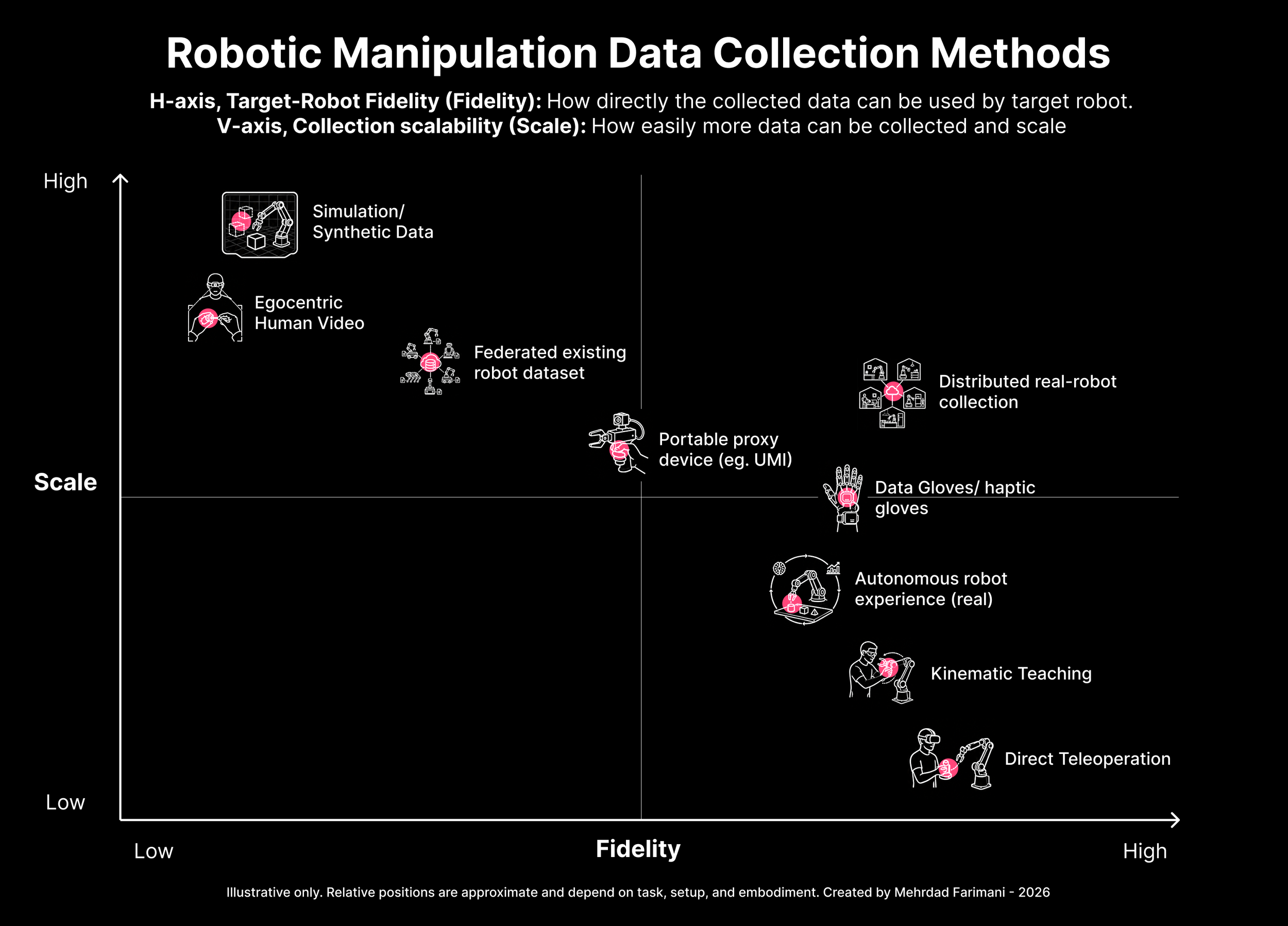
The main ways manipulation data is collected
Simulation/ Synthetic Data
Egocentric Human Video
Federated existing robot dataset
Portable proxy device (eg. UMI)
Distributed real-robot collection
Data Gloves/ haptic gloves
Autonomous robot experience (real)
Kinematic Teaching
Direct Teleoperation
Below, I’ll try to explain them extensively:
Press enter or click to view image in full size
1. Direct teleoperation
Teleoperation means that a human controls the physical robot while the robot records observations and actions.
Common interfaces include:
keyboard or joystick control
3D SpaceMouse devices
virtual-reality controllers
motion-capture systems
exoskeletons
leader-follower arms
miniature replicas of the target robot
bilateral haptic interfaces
The main advantage is alignment.
The human does not merely show what the task looks like. They generate actions through the target robot. The resulting dataset can contain exactly the variables the policy will later need to predict.
For example, a trajectory might contain:
[
a_t =
[\Delta x,\Delta y,\Delta z,\Delta r,\Delta p,\Delta yg]
]
where the first three values represent Cartesian translation, the next three represent orientation change, and (g) represents the gripper command.
If the deployment policy will output that same action representation, training becomes relatively straightforward.
SpaceMouse and VR control
End-effector teleoperation interfaces map human controller movement into a desired robot-hand pose.
They are flexible and comparatively inexpensive. The same controller can often operate different robots.
Their weakness is that the operator does not directly feel the robot’s kinematic configuration. The controller says where the hand should move, but not necessarily how the arm should arrange itself. Singularities, joint limits, self-collisions, and awkward elbow configurations may be difficult for the operator to anticipate.
Latency is another problem. Even 100 to 200 milliseconds can make precise contact feel disconnected. Operators compensate by moving more slowly and cautiously than they would during a natural demonstration.
Leader-follower systems
A leader arm has a similar or identical kinematic structure to the robot being controlled. Moving the leader produces corresponding motion on the follower robot.
GELLO is a well-known example. It uses a low-cost, scaled controller whose kinematics match the target arm. In its user study, GELLO produced more reliable and efficient demonstrations than other inexpensive interfaces such as VR controllers and SpaceMouse devices. The system was demonstrated with Franka, UR5, and xArm robots, including bimanual and contact-rich tasks.
This style of interface reduces the mental translation required from the operator. The person moves something shaped like an arm rather than moving a floating cursor in six-dimensional space.
The trade-off is hardware specificity. A controller designed around one arm does not automatically fit another arm.
ALOHA and Mobile ALOHA
ALOHA-style systems use smaller leader arms to teleoperate two follower arms. They became popular because they made relatively low-cost bimanual data collection practical.
Mobile ALOHA extended the setup with a mobile base and whole-body teleoperation. The system was used to collect demonstrations for tasks such as cooking, cabinet manipulation, elevator operation, and rinsing a pan. The work also showed that co-training on static ALOHA data could improve mobile-manipulation performance, even when only 50 task-specific demonstrations were available.
This highlights an important pattern: a small amount of highly aligned, task-specific data can become much more useful when combined with broader pretraining data.
Pros of direct teleoperation
Actions are already expressed through a robot.
Robot state and sensor data can be recorded directly.
Contact and dynamics correspond to the real hardware.
Demonstrations respect the robot’s reach and joint limits.
Data can be used directly for behavior cloning or offline reinforcement learning.
It is relatively easy to add force, torque, tactile, or audio sensing.
Cons of direct teleoperation
Collection speed is limited by robot speed.
Every trajectory consumes physical hardware time.
Resetting tasks can dominate total collection time.
Operators require training.
Bad interfaces produce awkward or low-quality demonstrations.
Data is often specific to one embodiment.
Hardware failures interrupt collection.
Safety constraints reduce exploration.
Collecting in many homes, factories, or public environments is logistically difficult.
Teleoperation remains the cleanest source of executable robot actions. It is also one of the hardest methods to scale geographically and economically.
Press enter or click to view image in full size
2. Kinesthetic teaching
In kinesthetic teaching, a human physically moves the robot arm through the desired motion.
This can work well with lightweight, backdrivable, or gravity-compensated arms. The operator guides the end effector directly while the robot records joint or Cartesian trajectories.
It is intuitive for simple paths:
moving between waypoints
opening a drawer
placing an object
guiding a wiping motion
teaching an insertion direction
It becomes less effective when the task requires:
coordinated bimanual motion
dynamic actions
continuous gripper control
mobile-base movement
precise force regulation
high-speed contact
dexterous fingers
The operator is also physically interacting with the robot, which changes the system’s dynamics. The forces recorded during demonstration may include the human pushing the robot rather than forces that should occur during autonomous execution.
Kinesthetic teaching is useful for collecting motion templates and small task datasets. It is not an obvious path to internet-scale robot learning.
Press enter or click to view image in full size
3. Distributed real-robot collection
Instead of moving a robot through many environments, distributed collection sends standardized robot setups to different locations.
DROID is one of the clearest examples. It contains approximately 76,000 demonstrations, or 350 hours of interaction, collected across 564 scenes and 84 tasks by 50 collectors in North America, Asia, and Europe. The project standardized the robot hardware, sensing, teleoperation interface, and collection protocol while varying the actual environment.
This design attacks one of the biggest weaknesses of traditional lab datasets: scene diversity.
A dataset collected entirely in one laboratory may contain many trajectories, but the same tables, walls, lighting conditions, camera backgrounds, and object arrangements appear repeatedly. A model can quietly memorize those regularities.
Distributed collection introduces real variation:
different homes
different furniture
different lighting
different room layouts
different operator habits
different object collections
At the same time, standardized hardware prevents every data source from having a completely different action space.
Pros
Real robot actions and real physical interaction
Greater environmental diversity than a single laboratory
Consistent hardware and sensor definitions
Easier dataset aggregation
Useful for testing out-of-distribution generalization
Cons
Shipping, maintaining, and calibrating many systems is expensive
Slight setup differences can still create hidden domain shifts
Operators may interpret task instructions differently
Data quality can vary between sites
One standardized embodiment may limit cross-robot generality
Troubleshooting becomes a distributed operations problem
Distributed collection is one of the strongest approaches when the objective is robust real-world behavior on a known class of robot.
Press enter or click to view image in full size
4. Federating existing robot datasets
Another strategy is to combine datasets that were originally collected by different laboratories for different purposes.
RoboNet was an early large-scale effort in this direction. It assembled 15 million video frames from seven robot platforms and showed that multi-robot pretraining could reduce the amount of data needed on a held-out robot.
Open X-Embodiment pushed the idea much further. The initial release combined more than one million real-robot trajectories from 22 embodiments, pooled from dozens of existing datasets and standardized into a common format. It included hundreds of skills and robots ranging from single arms to bimanual systems and quadrupeds.
This data has supported generalist policies such as Octo and OpenVLA. Octo was pretrained on roughly 800,000 Open X-Embodiment trajectories, while OpenVLA used approximately 970,000 episodes.
The attraction of federation
No single laboratory needs to collect everything.
Different datasets contribute different strengths:
one contains many environments
one contains language labels
one contains bimanual tasks
one contains precise assembly
one contains mobile manipulation
one contains unusual objects
one contains depth or force sensing
The combined model may learn reusable visual, semantic, and motor features.
The alignment problem
Federating robot data is not equivalent to concatenating video files.
Different datasets may disagree on:
coordinate frames
action units
action frequency
image resolution
camera count
gripper representation
task naming
episode termination
success labels
missing observations
controller type
Suppose one robot represents rotation using Euler-angle deltas and another uses axis-angle commands. One stores actions in the robot base frame and another uses the end-effector frame. One action means “desired pose,” while another means “change in pose during the next 100 milliseconds.”
These values cannot be mixed safely without careful normalization.
Even after standardization, the same action vector may have different physical consequences because robot dynamics, controllers, and grippers differ.
Pros
Reuses data that already exists
Provides cross-task and cross-embodiment diversity
Supports foundation-model pretraining
Encourages shared formats and open tooling
Can improve transfer to new robots
Cons
Inconsistent quality
Missing or incompatible modalities
Conflicting action semantics
Uneven task distribution
Duplicate or near-duplicate data
Dataset-specific shortcuts
Difficult attribution of which data actually helped
Federated data is excellent for broad pretraining. It is usually not a substitute for clean post-training data from the target robot.
Press enter or click to view image in full size
5. Portable proxy devices
Portable devices try to capture robot-relevant human demonstrations without operating a full robot.
The basic idea is simple: give the human a tool that resembles a robot end effector, record how that tool moves, and later transfer the trajectory to a robot.
Universal Manipulation Interface (UMI)
The Universal Manipulation Interface, or UMI, uses handheld grippers equipped with cameras and tracking. A person performs the task directly using the gripper rather than remotely controlling a robot.
UMI was designed to collect portable, in-the-wild demonstrations for dynamic, bimanual, precise, and long-horizon manipulation. Its relative-trajectory action representation and latency-matching strategy were intended to improve deployment across different robot platforms.
This changes the economics of data collection.
The operator is no longer waiting for a large robot to move. They can carry the device into a kitchen, workshop, office, or factory. Natural human motion is faster than teleoperation, and the setup is much easier to transport.
The device also constrains the demonstration toward a robot-compatible end effector. A human holding a parallel-jaw gripper cannot quietly use an unsupported finger motion that the target gripper will never reproduce.
Where proxy devices work well
Parallel-jaw manipulation
Bimanual tasks
Dynamic demonstrations
Long-horizon household activities
Collecting across many environments
Tasks where end-effector pose and opening width are sufficient
Where they struggle
The human arm still differs from the robot arm.
A portable gripper trajectory may pass through configurations that are easy for a person but difficult for a robot because of reach, collision, or joint-limit constraints.
The human also provides physical capabilities that the device may not measure:
arm compliance
body motion
force modulation
wrist stabilization
subtle contact adjustments
If the gripper contains only a camera and pose tracker, the trajectory may record where it moved without recording why it succeeded.
Adding touch
FreeTacMan extends this general idea toward robot-free visuo-tactile collection. Its reported dataset contains more than three million paired visual-tactile samples and over 10,000 demonstration trajectories across 50 contact-rich tasks.
This is an important direction because it combines two forms of scalability:
Human-speed, robot-free demonstration
Direct measurement of contact-related signals
The cost is increased device complexity, calibration burden, sensor fragility, and a larger transfer problem between the handheld device and the robot end effector.
Press enter or click to view image in full size
5. Data Gloves
Data gloves measure the human hand pose using bend sensors, IMUs, optical markers, or embedded cameras. They record finger-joint motion, wrist pose, and grasp shape while a person performs a task. In this case, they sit between egocentric human video and portable proxy devices. They provide much better hand-kinematic information than video alone, but the motion still has to be retargeted to the robot hand.
Teleoperation gloves directly control a dexterous robot hand. The human finger motion is mapped to robotic finger joints, sometimes while another system controls the robot arm. These belong under direct teleoperation. Their main value is that they capture detailed dexterous actions in a robot-executable setting, although the mapping is complicated because human and robot hands have different joint structures, ranges of motion, and contact geometries.
Haptic or exoskeleton gloves add resistance or force feedback. These can let the operator feel contact, object stiffness, or grasp pressure while controlling the robot. They offer higher-fidelity teleoperation, particularly for contact-rich tasks, but they are expensive, harder to calibrate, slower to deploy, and less scalable.
Their main advantages are:
detailed finger and wrist motion capture
natural control of multi-finger robot hands
less visual occlusion than camera-only hand tracking
potential ccess to grip force and contact information
useful data for dexterous grasping and in-hand manipulation
Their limitations are:
calibration varies between users and hand sizes
sensor drift and glove slippage
human-to-robot retargeting is still required
limited measurement of true fingertip forces unless the glove is instrumented
reduced natural touch when the glove covers the fingertips
higher setup time and cost than ordinary video
difficult scaling across many operators
On the scalability versus fidelity chart, I would separate them into three positions:
Basic motion-capture glove: medium-high scalability, medium fidelity
Robot teleoperation glove: medium scalability, high fidelity
Haptic exoskeleton glove: low-to-medium scalability, very high fidelity
A suitable section for the article could read:
Data gloves and haptic teleoperation
Data gloves capture the motion of the human hand using sensors embedded around the fingers and wrist. Depending on the setup, they may be used only to record human demonstrations or to directly control a dexterous robotic hand. Compared with ordinary video, gloves provide more reliable finger-joint information and are less affected by hand-object occlusion. However, the recorded motion is still human motion, not automatically robot motion. Differences in hand geometry, joint limits, and contact surfaces require retargeting before the data can be used by a robot.
More advanced systems use haptic or exoskeleton gloves that can apply resistance to the operator’s fingers. This gives the user some perception of contact while teleoperating the robot and can improve precise grasping or in-hand manipulation. The trade-off is that these systems are expensive, difficult to calibrate, and less comfortable for long collection sessions. Data gloves are therefore particularly valuable for dexterous robotic hands, but they are less necessary for robots using simple parallel-jaw grippers.
Press enter or click to view image in full size
6. Egocentric human video
Egocentric data is recorded from the human’s point of view, usually with a head-mounted camera, smart glasses, or mixed-reality headset.
This is probably the most scalable real-world source of manipulation behavior.
Humans already perform useful tasks all day. The collection device can be comparatively lightweight, and the environment does not need to be modified. A single person can generate many hours of varied interaction without a robot present.
EgoDex
EgoDex used Apple Vision Pro to collect 829 hours of egocentric manipulation video with paired 3D hand and finger tracking. It contains roughly 338,000 demonstrations across 194 tabletop tasks, totaling about 90 million frames.
This is dramatically more hand-motion data than most robot datasets can provide.
The native hand tracking is critical. Ordinary video tells us where pixels moved. Tracked skeletal data gives an estimate of:
wrist pose
finger-joint locations
hand articulation
bimanual coordination
camera otion
More recent efforts are scaling this idea further. EgoVerse reports 1,362 hours of human demonstrations across 240 scenes, 1,965 tasks, and more than 2,000 demonstrators, with 3D hand and head poses and subtask descriptions.
EgoScale reported pretraining on more than 20,000 hours of action-labeled egocentric human video, followed by a smaller human-robot alignment stage. Its results suggest that human data can act as a reusable motor prior, particularly for dexterous manipulation, while still requiring robot-aligned data for effective transfer.
What human video gives us
Human video is excellent for learning:
object semantics
task intent
scene understanding
common action sequences
hand-object relationships
long-horizon task structure
natural variation
rare tasks
diverse environments
human preferences about how tasks are performed
It may teach a model that a mug is usually grasped by its body or handle, that a drawer must be opened before an object is placed inside, or that a towel should be aligned before it is folded.
What it does not give us directly
Human video usually does not provide:
robot motor commands
robot joint trajectories
robot torque targets
target-controller behavior
robot-specific collision constraints
reliable grip force
full contact geometry
exact friction
actuator limits
robot-camera appearance
Even perfect human hand tracking does not solve the problem.
A human hand might have more than 20 controllable degrees of freedom. A robot may have a two-finger gripper, a three-finger hand, or a dexterous hand with a different joint layout. Mapping between them is a retargeting problem.
Retargeting
Retargeting converts a human trajectory into a robot-compatible trajectory.
A simple retargeting method may minimize the distance between human and robot fingertips:
[
q_r^* =
\arg\min_{q_r}
\sum_i
|p_i^{robot}(q_r)-p_i^{human}|²
]
subject to:
robot joint limits
collision constraints
contact constraints
kinematic feasibility
But matching fingertip positions does not guarantee equivalent manipulation.
Two hands can place fingertips at the same locations while producing different:
normal forces
frictional forces
palm contacts
pressure distributions
object stability
Retargeting also becomes ambiguous when fingers are hidden behind an object.
Object-centric alternatives
Instead of reproducing every finger joint, a system can focus on:
object pose
wrist pose
contact region
task affordance
desired object motion
This is often more robust for robots whose hands differ substantially from human hands.
For example, if a human rotates a bottle cap, the transferable information may be:
stabilize the bottle
grasp the cap
apply rotation around the cap axis
maintain downward contact
stop when the thread releases
The exact human finger trajectory may matter less than the object-level constraints.
This approach has limits. In-hand rotation, finger gaiting, knot tying, and delicate tool manipulation may genuinely depend on fine finger coordination.
Pros of egocentric human data
Very high collection speed
Low dependence on robot availability
Large environmental diversity
Natural human motion
Long-horizon task structure
Rich semantic content
Potentially huge numbers of operators and scenes
Increasingly accurate hand and camera tracking
Cons
No native robot actions
Large embodiment gap
Weak or absent contact measurements
Retargeting errors
Human hands may use capabilities unavailable to the robot
Occlusion remains severe
Privacy and consent issues in homes and workplaces
Visual appearance differs from robot-mounted cameras
Demonstrations may be physically impossible for the target robot
Human video is likely to become a major pretraining source. It is unlikely to eliminate the need for robot data.
Press enter or click to view image in full size
7. Simulation and synthetic data
Simulation offers something the real world cannot: almost unlimited resettable interaction with complete state information.
A simulator can provide:
exact object poses
exact contact points
collision information
joint states
force values
segmentation masks
depth
rewards
success labels
counterfactual trajectories
Objects can be randomized. Cameras can move. Lighting can change. Thousands of environments can run in parallel.
RoboCasa and RoboCasa365
RoboCasa introduced diverse simulated kitchen environments, thousands of objects, and 100 everyday tasks. It combined human demonstrations with automated trajectory generation.
RoboCasa365 expanded this into 365 tasks across 2,500 kitchen environments, with more than 600 hours of human demonstration data and over 1,600 hours of synthetically generated demonstrations.
This type of environment is useful for controlled scaling studies. Researchers can vary:
task count
scene count
object diversity
demonstration count
robot type
and observe which form of diversity actually improves generalization.
The simulation-to-reality gap
Simulation fails when the learned policy depends on something that the simulator models incorrectly.
Common gaps include:
friction
deformable materials
cable behavior
transparent objects
reflective surfaces
contact compliance
motor delays
backlash
camera noise
calibration drift
object mass
gripper wear
A simulated cloth may be too stiff. A simulated drawer may move too smoothly. A simulated object may have an unrealistically clean collision mesh.
The policy can become excellent at exploiting these errors.
Domain randomization
Domain randomization deliberately varies simulation parameters:
textures
lighting
camera pose
object size
friction
mass
latency
noise
The idea is to prevent the model from relying on any one simulation-specific regularity.
This helps, but randomness is not automatically realism. Randomizing the wrong variables over unrealistic ranges can make training harder without improving real-world performance.
Pros
Extremely scalable
Parallelizable
Safe
Cheap resets
Perfect labels
Easy failure collection
Easy rare-event generation
Supports reinforcement learning
Reproducible evaluation
Can cover configurations that are dangerous to collect physically
Cons
Imperfect physics
Imperfect sensors
Unrealistic object assets
Simulated visual shortcuts
High-quality environment creation is still expensive
Contact-rich transfer remains difficult
Success in simulation may say little about deployment robustness
Simulation is strongest when combined with real data, not when treated as a replacement for reality.
Press enter or click to view image in full size
8. Autonomous robot experience
Human demonstrations show what good behavior looks like. Autonomous rollouts show what the current policy actually does.
Once a robot can perform a task occasionally, it can collect additional experience by attempting the task repeatedly. This produces:
successes
partial successes
failures
recovery opportunities
states that human demonstrators rarely visit
SOAR demonstrated autonomous real-world collection of approximately 30,500 trajectories across five tabletop environments. Its pipeline used foundation models to propose goals and estimate success, and the resulting data approximately doubled performance across its evaluation settings.
This is a potential data flywheel:
collect demonstrations
train a policy
deploy the policy
record failures and successes
relabel or score the experience
retrain
repeat
The difficult part is not recording the rollout. It is deciding what happened.
Autonomous labeling problems
A system must determine:
Was the task completed?
Was it partially completed?
Which subtask failed?
Did the robot damage anything?
Is the environment safe to reset?
Is the collected trajectory useful?
Should the behavior be reinforced or avoided?
Incorrect success labels can poison the training data.
Resetting is another unresolved issue. A robot that places every object into a box eventually runs out of objects. Someone or something must restore the scene.
Autonomous collection is therefore easiest for tasks with automatic resets or reversible state transitions. It becomes much harder in homes and factories where actions create persistent changes.
Pros
Collects data from the policy’s real state distribution
Produces useful failures
Reduces human control effort
Supports reinforcement learning and self-improvement
Can target uncertain or difficult states
Becomes more valuable as the initial policy improves
Cons
Requires a reasonably capable initial policy
Automatic success detection is unreliable
Resetting remains expensive
Unsafe exploration can damage hardware or environments
Early policies may generate repetitive, low-quality data
Distribution can collapse around current capabilities
Autonomous data is likely to matter increasingly, but it generally sits near the top of the stack. A robot must already know enough to explore without producing only noise.
Contact data: the missing layer
Manipulation is about contact. Yet many large datasets are primarily visual.
This is understandable. Cameras are cheap, familiar, and information-dense. One image can show objects, colors, geometry, scene context, and task progress.
But images do not directly measure physical interaction.
Force-torque sensing
A six-axis force-torque sensor typically measures:
[
w = [F_x,F_y,F_z,\tau_x,\tau_y,\tau_z]
]
This describes the net force and torque passing through the sensor.
A wrist-mounted sensor can tell the robot that something is pushing against the hand. It cannot necessarily say which finger is making contact or how pressure is distributed across the gripper.
It is useful for:
insertion
wiping
polishing
tool use
detecting unexpected collision
estimating contact direction
regulating applied force
Tactile sensing
Tactile sensors measure contact closer to the surface.
Depending on the technology, they may estimate:
pressure distribution
shear
contact shape
slip
texture
vibration
local deformation
Tactile data is especially useful after the object becomes visually occluded by the hand.
RH20T is an early large multimodal example, with over 110,000 contact-rich sequences containing visual, force, audio, action, and, in some configurations, tactile information.
More recent datasets are becoming both larger and more specialized. OmniViTac reports more than 21,000 visuo-tactile-action trajectories across 86 tasks and over 100 objects, organized around different physical interaction patterns.
Why tactile data is difficult to scale
Tactile sensors are not passive cameras.
They touch the world, so they:
wear
tear
get dirty
deform
drift
requie calibration
change the contact mechanics
differ substantially between hardware designs
High-resolution tactile images are also expensive to store and process. A system with two tactile cameras running at high frequency can add a large amount of data to every trajectory.
Sensor placement matters. A fingertip sensor sees fingertip contact but not palm contact. A wrist force-torque sensor measures the net wrench but loses spatial detail.
There is no universally accepted tactile representation equivalent to RGB images.
Audio
Audio is often treated as an extra modality, but it can reveal important contact events:
a latch clicking
a gear engaging
an object scraping
liquid pouring
a tool striking a surface
a package tearing
Audio is cheap to collect and easy to synchronize. It is also affected by background noise and usually cannot localize contact by itself.
The broader lesson is that manipulation datasets should not add sensors merely because they are available. Each sensor should correspond to an uncertainty that matters for the task.
A snapshot of major datasets
The following examples illustrate how differently “large-scale” can be defined.
Press enter or click to view image in full size
A snapshot of major datasets
BridgeData V2 contains 60,096 trajectories across 24 environments. RoboMIND’s expanded release reports 107,000 demonstrations across 479 tasks, including 5,000 failure demonstrations and four robot embodiments. AgiBot World reports more than one million trajectories across 217 tasks and five deployment scenarios.
These numbers should not be treated as a leaderboard. A human-video episode, a simulated episode, and a real-robot trajectory contain different information and have different collection costs.
Data quality is an engineering problem
Once a collection method is selected, the unglamorous engineering decisions become extremely important.
A policy cannot recover information that was never recorded correctly.
Camera placement
A typical manipulation setup may contain:
one or more static scene cameras
a wrist camera
a head camera
depth sensors
Static cameras provide stable global context. They can see the table, objects, and robot configuration, but the robot may occlude the task.
Wrist cameras provide close-up views of the active area, but they suffer from:
rapid motion
blur
changing viewpoint
contact occlusion
limited global context
Multiple views help, but they increase storage, synchronization complexity, and model cost.
Calibration
Camera intrinsics describe how 3D points project into image pixels.
Camera extrinsics describe where the camera is located relative to another coordinate frame, such as the robot base.
Incorrect calibration can make a clean-looking dataset geometrically inconsistent.
For a wrist camera, hand-eye calibration must relate the camera frame to the end-effector frame. A few millimeters of error may be acceptable for rough pick-and-place tasks and catastrophic for insertion.
Calibration should not be treated as a one-time setup step. Mounts move. Screws loosen. Robots are transported. Calibration validity should be checked throughout collection.
Synchronization
Imagine that the image at timestamp (t) is paired with the action from (t+100) milliseconds.
For slow motion, the error may appear harmless. During a fast grasp or collision, the recorded action may correspond to a completely different physical state.
Every data stream should use a clear time base:
camera exposure time
robot-state measurement time
command-send time
tactile sample time
audio time
operator-input time
Resampling everything to a common frequency is convenient but can hide latency.
For example, linearly interpolating joint positions may be reasonable. Interpolating a binary gripper transition or contact event may not be.
Observed state versus commanded state
The action sent to the robot is not always the action the robot executed.
A controller may saturate, clip, delay, smooth, or reject a command. The arm may collide with the environment. The gripper may stop before reaching the requested width.
A strong dataset records both:
commanded action
measured resulting state
Without this distinction, a model may learn from targets that were never physically realized.
Action representation
Action representation determines what the policy must learn.
Joint-space actions
Joint-space commands map directly to the robot but are highly embodiment-specific.
They can be useful when:
the target robot is fixed
whole-arm posture matters
collision avoidance depends on joint configuration
high-precision control is needed
Cartesian end-effector actions
Cartesian actions are easier to share across arms.
They can represent translation, rotation, and gripper state. An inverse-kinematics controller converts these actions into joint motion.
The drawback is that the policy loses direct control over redundant arm configurations. The same end-effector pose may correspond to several elbow positions, some safe and some unusable.
Absolute versus relative actions
Absolute actions specify a target pose.
Relative actions specify a change from the current pose.
Relative actions are often easier to normalize across workspaces and robot embodiments. Absolute actions can provide stronger global consistency when calibration is accurate.
Action chunks
Instead of predicting one action, many modern policies predict several future actions:
[
[a_t,a_{t+1},…,a_{t+H}]
]
This can produce smoother behavior and reduce the impact of inference latency.
The dataset must still support the policy’s execution frequency. Predicting a 50-step chunk from data recorded at an unstable frame rate is not a clean supervision problem.
Language labels
Language is often added after data collection.
Annotations may describe:
the overall task
a subtask
the object
the target location
the observed result
the reason for failure
Loose language increases semantic diversity but can introduce ambiguity.
“Put the cup away” may mean:
place it in a cabinet
place it in a drawer
move it off the table
return it to a marked location
For control, instructions should be grounded in what is visible and measurable.
Language-label generation using large models can reduce annotation cost, but generated labels should be audited. A fluent description can still be physically wrong.
Success and failure labels
Binary success labels are convenient and often inadequate.
A long task may fail after completing four of five subtasks. Treating the whole trajectory as equivalent to an immediate failure discards useful structure.
Better labels may include:
task progress
completed subtasks
failure time
failure type
object state
recoverability
safety severity
RoboMIND’s inclusion of thousands of failure demonstrations is notable because failure data is still underrepresented in many large robot datasets.
Dataset splits
A random frame split is usually misleading.
Adjacent frames from one trajectory are nearly identical. If frames from the same episode appear in training and testing, evaluation becomes meaningless.
Useful test splits hold out combinations such as:
unseen objects
unseen object instances
unseen rooms
unseen camera viewpoints
unseen operators
unseen task formulations
unseen robot embodiments
unseen object-task combinations
The split should reflect the generalization claim.
A model evaluated on new positions of familiar objects is not necessarily demonstrating object generalization. A model evaluated in the same room with slightly different lighting is not demonstrating environmental generalization.
Choosing a collection method
A useful way to compare collection methods is to ask six questions.
1. Does it provide executable actions?
Direct teleoperation: yes.
Simulation: yes, within the simulated robot.
Proxy devices: approximately.
Human video: usually no.
2. Does it capture real contact dynamics?
Real-robot teleoperation: yes.
Instrumented proxy devices: partly.
Human video: indirectly.
Simulation: only as accurately as contact is modeled.
3. Can it scale across environments?
Human video: very well.
Portable devices: well.
Distributed robot collection: moderately well.
Fixed laboratory teleoperation: poorly.
Simulation: extremely well, within generated environments.
4. Can it scale across embodiments?
Human video: visually yes, mechanically no.
Federated robot data: partially.
Simulation: yes, if robot models exist.
Direct teleoperation: usually tied to the target hardware.
5. Does it include failure states?
Autonomous rollouts: naturally.
Unfiltered teleoperation: potentially.
Curated demonstrations: usually not enough.
Human video: mostly successful human behavior.
Synthetic generation: failures can be generated deliberately.
6. Is the dataset aligned with deployment?
Target-robot teleoperation has the strongest alignment.
Every step away from the target robot adds a transfer problem:
different robot
different controller
different camera
different hand
different environment
different physics
different action representation
That does not make distant data useless. It changes what the data should be expected to teach.
The state of the field in 2026
The main trend is not that one data source is replacing the others.
The field is converging toward hybrid data stacks.
A modern foundation model may be trained using a combination of:
Internet-scale images and text for semantics
Human video for task structure and motion priors
Simulation for scale and controlled variation
Heterogeneous robot datasets for broad motor pretraining
High-quality target-robot demonstrations for alignment
Autonomous rollouts for failure correction and improvement
Tactile or force data for contact-rich post-training
GR00T N1 explicitly describes training on a heterogeneous mixture of real-robot trajectories, human videos, and synthetically generated datasets. Physical Intelligence’s (\pi_0) similarly starts from broad vision-language knowledge and diverse robot data, then uses higher-quality robot data for downstream adaptation.
This resembles a pyramid.
At the bottom is data that is abundant but weakly aligned:
web images
ordinary video
egocentric human demonstrations
In the middle is data that is more structured:
tracked hand motion
proxy-device demonstrations
simulated robot trajectories
multi-embodiment robot datasets
At the top is data that is scarce but highly aligned:
target-robot demonstrations
real contact data
corrections
failures
task-specific autonomous experience
The lower layers teach broad concepts. The upper layers teach what the particular robot must physically do.
The exact proportions depend on the task.
A robot sorting rigid packages may benefit heavily from vision and parallel-jaw teleoperation. A robot tying shoelaces will need much richer hand and contact information. A robot inserting parts on a production line may need less visual diversity but much better force control and calibration.
Press enter or click to view image in full size
Robotics data collection abundance
The open problems
We still do not know the best data mixture
More robot data helps in many settings, but different sources have different marginal value.
An additional hour of target-robot correction data may be worth more than another hundred hours of loosely related human video. At an earlier stage of training, the opposite may be true.
The field needs better methods for estimating:
which dataset contributed to a capability
which data is redundant
which conditions are underrepresented
which trajectory should be collected next
when synthetic data stops helping
when embodiment mismatch becomes too large
Contact remains underrepresented
Vision-centric models are improving rapidly, but many real tasks depend on physical variables that images only weakly reveal.
The open question is not whether tactile sensing is useful. It is how to collect, standardize, pretrain, and transfer tactile data at scale.
A future tactile foundation model may require data across many sensor types, contact geometries, materials, and robot hands. Today those representations remain fragmented.
Human-to-robot transfer is still incomplete
Tracked human motion is becoming abundant. Conversion into reliable robot behavior remains difficult.
The biggest gaps are:
embodiment
contact
force
occlusion
feasibility
camera viewpoint
control timing
Large human datasets are most convincing as pretraining sources, not as proof that robot-specific data has become unnecessary.
Dexterous hands on a humanoid make everything harder
A parallel-jaw gripper may need one scalar to describe opening width.
A dexterous hand may require control of 15 to 25 joints, possibly with coupled or underactuated mechanisms. Small retargeting errors can cause major contact changes.
Dexterous manipulation will likely need a combination of:
human hand data
object tracking
tactile sensing
simulation
robot-specific demonstrations
reinforcement learning
high-frequency local controllers
Data governance will become a real issue
Egocentric collection in homes and workplaces may capture:
faces
personal belongings
confidential documents
computer screens
proprietary processes
bystanders
location information
Industrial-scale collection also raises questions about consent, worker monitoring, ownership, and compensation.
These are not separate from technical design. Privacy constraints determine where data can be collected, what can be released, and which models can be reproduced.
Evaluation is lagging behind collection
It is easier to report that a dataset contains one million trajectories than to prove that those trajectories produced a generally capable robot.
Real-world evaluation is expensive and statistically noisy. Tasks are difficult to reproduce exactly. Hardware differs. Success definitions vary.
Without stronger shared evaluation protocols, dataset scale can become a marketing number rather than a scientific measurement.
Final takeaway
The state of robotic manipulation data collection can be summarized in one sentence:
The field is getting much better at collecting different kinds of partial information.
Teleoperation gives us executable actions but is expensive.
Distributed robot collection gives us environmental diversity but creates operational overhead.
Federated datasets give us scale across robots but introduce incompatible action spaces and uneven quality.
Portable proxy devices give us faster, more natural demonstrations but still require transfer to the target robot.
Egocentric human video gives us enormous semantic and behavioral diversity but does not directly provide robot control.
Simulation gives us scale, labels, and safe exploration but models an approximation of reality.
Autonomous rollouts give us the policy’s real failures but require resets, success detection, and an already-capable system.
Tactile sensing gives us direct information about contact but remains difficult to standardize and scale.
So the winning strategy is unlikely to be one sensor, one dataset, one robot, or one collection device.
It will be a carefully constructed mixture in which each source is used for what it measures well.
Broad data teaches the model what is possible.
Robot data teaches it what is executable.
Contact data teaches it what is physically happening.
Failure data teaches it what to do when the plan stops working.
That last part may end up being the difference between a robot that performs a polished demonstration and a robot that is actually useful.
Cheers
