
It’s Sunday morning. I’m on a train to Stockholm. Sweden is dark, but every home has beautiful Christmas lights. I thought there’s nothing better to do than share some of my observations from the year that just passed regarding robotics. :)
The year is coming to its end, and it truly was an exciting one for robotics. Below are some of my observations, very much prone to be challenged. Anecdotal and non-structured, try to make sense of it yourself :)
We saw faster growth in humanoids than the previous year. The number of companies almost doubled, and the investment going into them increased a lot. As expected.
Also as expected, quadrupeds slowed down. It seems companies are still trying to find strong applications for quadrupeds. The main challenge might be that the price and system complexity are not justified by the relatively low-value use cases. Instead, we see more wheel-based UGVs appearing, with new and interesting form factors.
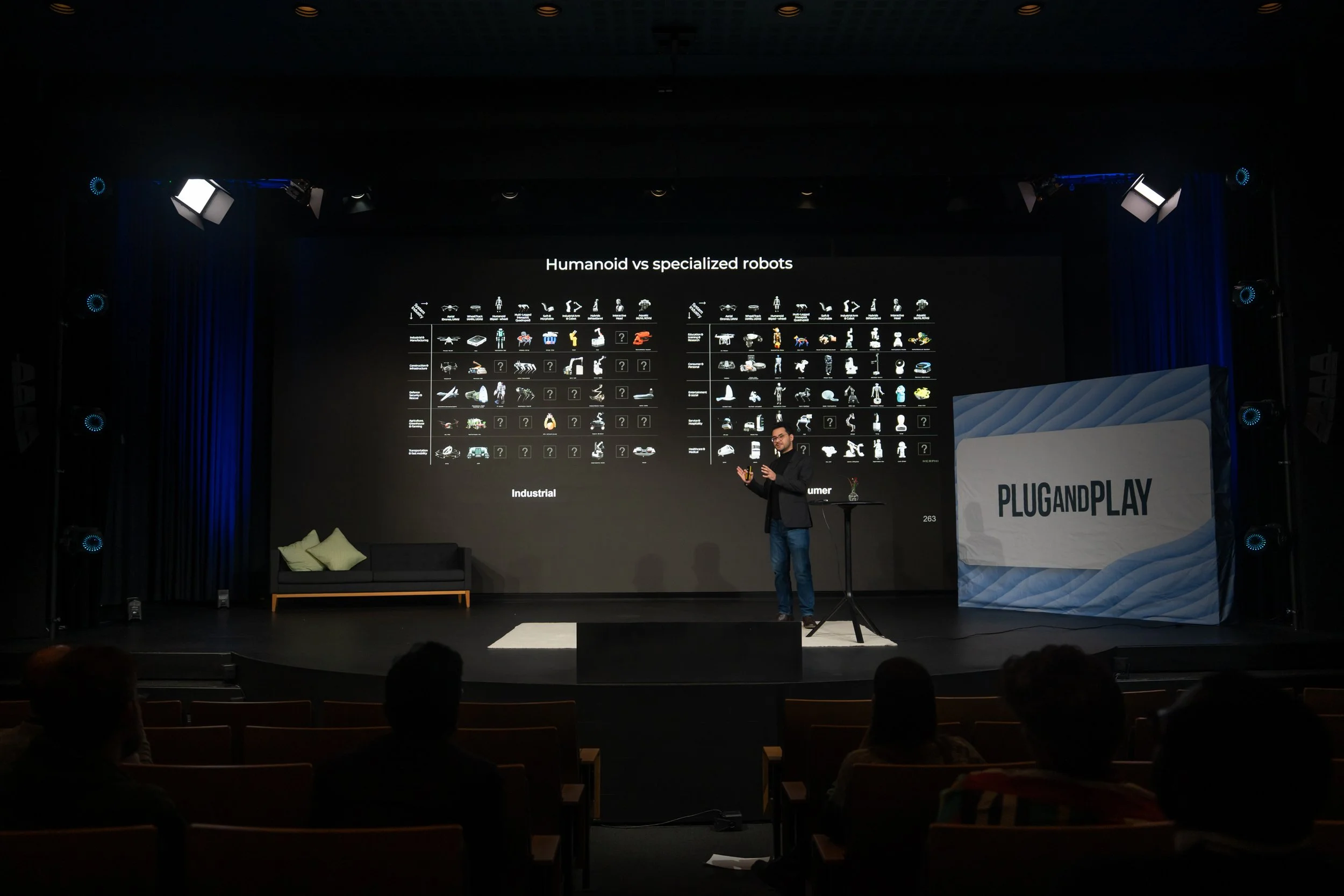
While general-purpose robotics is still the main dialogue, we continue to see specialised and single-use robotics gaining popularity. That said, very few companies are reaching real scale, or even a clear projection of scale.
Yet, many companies still want to build hardware and fundamental models before finding valuable use cases or integrations. There is interest from people in certain industries, but it often stops there.
Hands and dexterous manipulation were the dialogue of the year. Over 36 companies are actively developing hands and grippers for robotics, and 21 of them showed real progress, as described in the latest hand poster.
Another popular manipulation approach is placing cameras on the wrist or inside the palm. Useful solutions, but probably not permanent ones.
Human-like dexterous hands were not the only popular approach. Unique grippers with three fingers (Atlas, Sunday Robotics, etc.) received more attention. These form factors are still questioned in terms of how ubiquitous they can be and whether they truly make data collection easier.
At least 17 companies approached me this year saying they are developing tactile sensors for robotic grippers or hands. This is a real need, but also a very complex system with a tough business model to push through. Hardware integration is key here, but there are simply too many different form factors.
A popular humanoid approach this year was wheel-based platforms with a 3 to 4 DoF base and a full upper body. This is clearly an avenue many robotics companies started to explore. I will create an infographic for this, as I predict we will see even more of them in 2026.
Design, my favorite topic, received a lot of attention. It is getting competitive, and companies are innovating more in design, whether in safety, coverage, materials, or visual language.
I did not see many robots with a strong focus on human-robot interaction, which is disappointing. However, I connected with many researchers working on HRI, and we discussed several areas of potential. We will keep producing more knowledge and content in this space.
Building the “brain” for robots was another major theme. Up to 13 companies came out of stealth trying to build datasets, foundation models, training pipelines, RL-based control algorithms, and more. Very exciting progress to watch.
Hardware is still a major limitation. It is still struggling, and its weaknesses are becoming more apparent as robots operate for longer periods of time.
The supply chain is still vague and broken. It is being built, but we need more companies to fill the gaps.
Investment has certainly increased, but in a non-linear way, and it is hard to identify clear patterns. I was approached by at least 18 VCs and investors this year trying to identify the next unicorn in robotics. I worked with a few of them, but there is still a long way to go.
As for MERPHI, we were involved in seven full-on robotics projects in 2025, and we are still designing robots at full speed. We are almost fully booked for the first half of 2026, but let’s chat if you have a project.
As for myself and consultancy, I am always happy to chat :)
There is much more to say, but I want to enjoy the Swedish winter nature. Enjoy your holidays, and let the coming year be a locomoted year for “good” robotics.
