
For Decades, Humanoids Walked Like They Were Squatting. Why?
From the crouched walking of early humanoids to today's more natural gaits: how advances in locomotion control, biomechanics, actuator technology, and energy efficiency changed the way humanoid robots walk.
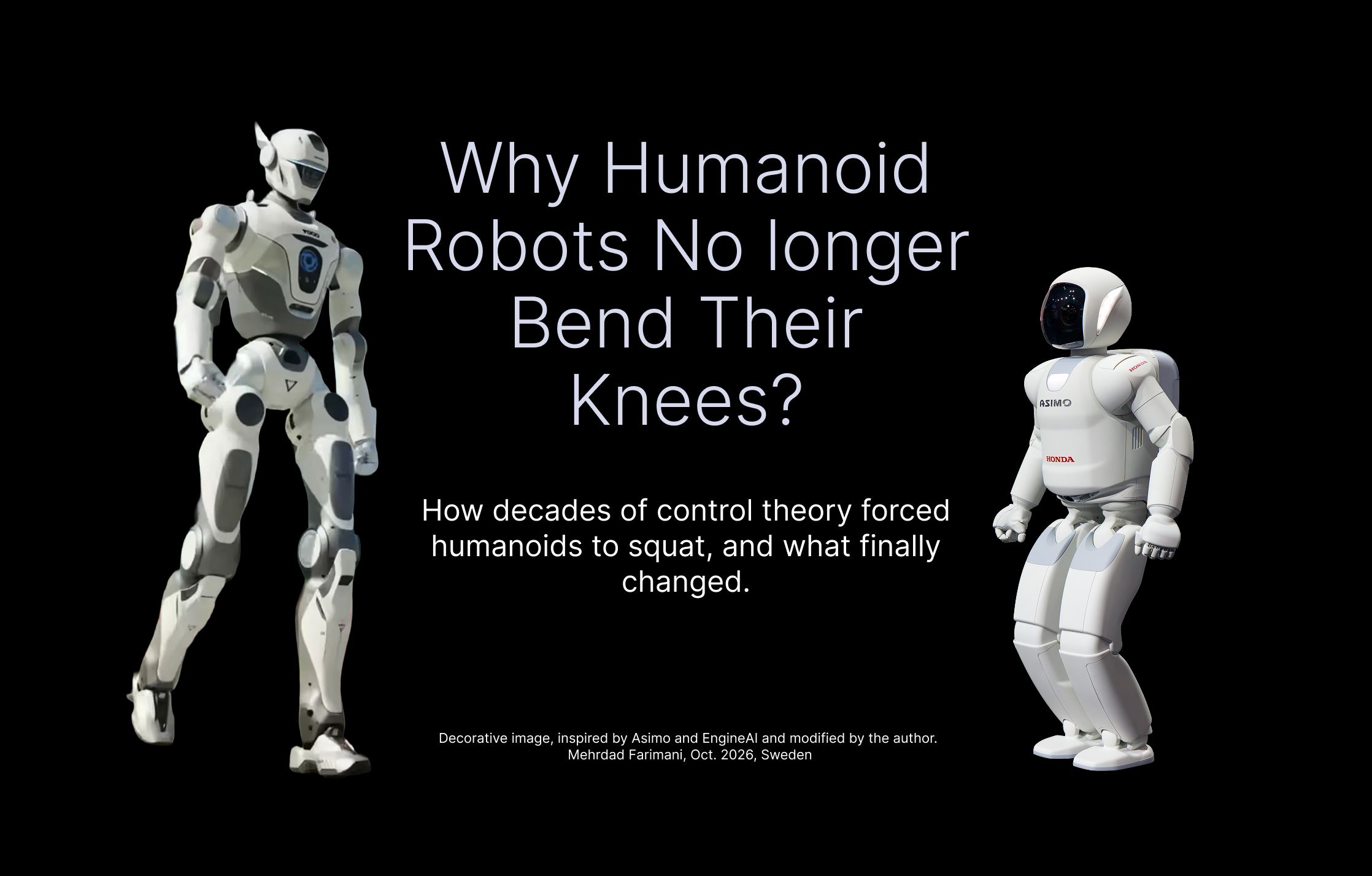
If you've been in the humanoid robotics industry for more than ten years, you probably remember that most humanoid robots used to walk with their knees permanently bent. ASIMO, HRP-2, and even the earlier versions of Boston Dynamics' Atlas had that characteristic walking posture, almost as if they were constantly squatting.
Today, if you look at most modern humanoids, you'll notice something has changed. Their legs are considerably straighter during walking, and their movements are starting to resemble the way humans actually walk.
So, what happened? Why did we spend decades designing humanoids that walked with bent knees, only to eventually straighten them?
I remember asking myself the same question years ago. I discussed it with a few colleagues, including Professor Majid Khadiv, who explained something fundamental about human locomotion.
When humans walk, we are essentially allowing our bodies to fall forward in a controlled manner, catching ourselves with the next step. We also take advantage of the entire foot, from heel strike to toe-off, allowing our body to move over the supporting leg.
Of course, human walking is more complicated than simply falling forward. But that explanation highlights an important difference between the way humans walk and how we traditionally programmed humanoid robots to walk.
And it turns out that the bent-knee walking problem has much more to do with mathematics, control strategies, and energy consumption than with the knee itself.
The problem started with how we modeled walking
For many years, one of the dominant approaches to humanoid locomotion was based on the Linear Inverted Pendulum Model (LIPM), often combined with Zero Moment Point (ZMP) control.
The idea was relatively simple: instead of calculating the complete dynamics of a complicated humanoid robot, we could approximate its motion using a simplified inverted pendulum.
One of the conventional assumptions of this model was that the robot's center of mass (CoM) should remain at a constant height.
This made the mathematics considerably easier, particularly for planning dynamically balanced walking trajectories.
But here's the problem.
Imagine walking with your pelvis maintained at exactly the same height throughout every step. As your supporting leg moves underneath your body, your knee must constantly bend or extend to compensate for the changing geometry.
That's one of the main reasons older humanoids walked with bent knees. The posture allowed them to maintain a relatively constant CoM height without reaching the mechanical limits of their legs.
There was another advantage: avoiding kinematic singularities.
When a robotic knee becomes fully extended, the leg approaches a singular configuration. Near that position, certain Cartesian movements become difficult to achieve through joint motion, and conventional inverse kinematics can become numerically problematic.
Keeping the knee slightly bent provided additional control authority and made the walking problem easier to solve.
So, the bent-knee posture wasn't necessarily a mechanical design decision. It was largely a consequence of the constraints we introduced to make humanoid locomotion mathematically manageable.
Researchers were already discussing this issue long before the recent humanoid boom. A 2010 study by Li and colleagues demonstrated straighter-knee walking with heel-strike and toe-off for the iCub robot in simulation. [1]
Humans don't maintain a constant center of mass height
If you observe a person walking from the side, you'll notice that their pelvis moves vertically during each step.
Our center of mass generally rises as the body passes over the supporting leg and descends during the transition toward the next step.
This movement is closely related to the inverted pendulum mechanics of human walking.
Instead of continuously forcing the pelvis to remain at the same height, the leg acts approximately like a pendulum support, allowing the body to progress over it.
This is where the explanation Professor Khadiv gave me becomes particularly relevant.
We exploit gravity, momentum, and the geometry of our limbs to move forward. The next step provides a new support before the body loses balance.
Modern humanoid controllers have become much better at handling this variable CoM height, more complicated contact dynamics, and the transitions between supporting legs.
However, there's an important technical distinction here. ZMP control itself does not require bent knees or constant CoM height. Those limitations came largely from the simplified models and trajectory-generation methods commonly used with it.
In fact, researchers demonstrated in 2016 that a robot could still use LIPM for high-level planning and achieve straighter-leg walking through an optimization-based low-level controller. [2]
Bent knees are expensive
Another major reason for abandoning permanently bent-knee walking is energy consumption.
Try walking around your room with your knees constantly bent. You'll probably notice how quickly your quadriceps start working.
Now imagine maintaining that posture for several hours.
A similar mechanical problem exists in humanoid robots.
The knee actuator must produce torque to counteract the moment generated by the ground reaction force.
In simplified terms:
Knee torque ≈ Ground reaction force × Perpendicular moment arm
Let's consider a robot with approximately 700 N of vertical ground reaction force acting on its supporting leg.
If the force passes 10 cm away from the knee joint:
Torque = 700 × 0.10 = 70 Nm
Now imagine straightening the leg so that the moment arm decreases to 2 cm:
Torque = 700 × 0.02 = 14 Nm
That's an 80% reduction in the gravitational component of knee torque in this simplified example.
Of course, this doesn't mean the robot consumes 80% less electrical energy. Actual energy consumption depends on joint velocities, transmission efficiency, dynamic forces, and the work done by other actuators.
Nevertheless, the mechanical advantage is significant.
A straighter supporting leg allows more of the robot's weight to be supported through its structure, reducing the continuous torque demand on the knee actuator.
For battery-powered humanoids, this matters enormously.
Studies on knee-stretched walking have demonstrated reductions in knee torque and improvements in locomotion efficiency compared with conventional bent-knee gaits. [2, 3]
We also forgot about the foot
There's another important factor that I believe deserves more attention: the foot.
Humans don't normally lift their entire foot vertically, move it forward, and place it flat on the ground again.
We typically initiate contact with the heel, transfer the load forward through the foot, and finish with toe-off.
During this process, the effective support point moves, and the foot rolls relative to the ground.
This allows the body to progress forward more naturally and contributes to smoother transitions between steps.
Many older humanoid locomotion strategies were designed around maintaining a flat foot against the ground for much of the stance phase.
That was convenient for calculating contact forces and keeping the ZMP inside a relatively predictable support polygon.
But it also introduced restrictions on the robot's movement.
Allowing heel-strike and toe-off changes the effective leg geometry during walking and can help the robot achieve longer steps without excessive knee flexion.
Interestingly, this doesn't necessarily require articulated toes. Even a rigid robotic foot can rotate around its heel or front edge.
By 2018, researchers at IHMC had demonstrated straighter-leg walking on Atlas using underconstrained whole-body control, including toe-off behavior that emerged without explicitly prescribing the foot's pitch trajectory. [4]
So, what actually changed in recent humanoids?
I would point to three developments.
First, locomotion controllers became less restrictive.
Instead of forcing the robot to follow simplified trajectories with constant CoM height, modern optimization-based controllers can handle more complicated whole-body dynamics, joint constraints, and contact conditions.
Model Predictive Control (MPC), whole-body optimization, and related methods have made it more practical to plan and execute these movements.
Second, actuators and their control systems improved.
Higher-bandwidth torque control, better sensing, and more capable electromechanical systems allow humanoids to react to disturbances and regulate ground contact forces more effectively.
This is important because straightening the supporting knee reduces the ability to rapidly extend the leg to recover balance.
The robot must compensate through coordinated ankle, hip, and whole-body movements, along with appropriate foot placement.
Third, reinforcement learning changed how locomotion strategies can be developed.
Instead of explicitly defining every joint trajectory, engineers can train policies in simulation to optimize walking under different conditions.
Figure's 2025 demonstration of reinforcement-learning-based locomotion is one example. Their controller was trained using simulated robots with randomized physical parameters and transferred to hardware using high-frequency torque feedback. [5]
However, there's a detail worth mentioning: reinforcement learning doesn't automatically produce human-like walking.
Figure explicitly incorporated human walking reference trajectories into its reward structure to encourage characteristics such as heel strike, toe-off, and synchronized arm movements.
So even with modern AI approaches, the objectives we define still influence the resulting gait.
Does this mean bent knees were wrong?
No. And I wouldn't conclude that every humanoid should now walk with fully extended knees.
Bent knees provide advantages, particularly for dynamic balance, sudden changes of direction, absorbing impacts, and recovering from disturbances.
A slightly flexed knee allows the supporting leg to extend or compress in response to external forces.
A completely straight knee can introduce singularity problems and reduce control authority.
Even humans don't walk with fully extended knees throughout the entire gait cycle. We flex our knees during swing to achieve ground clearance and bend them during loading response to absorb impacts.
The objective is to avoid unnecessary knee flexion during the weight-bearing phase, rather than eliminating knee flexion entirely.
And depending on the robot's mechanical architecture, actuator characteristics, and intended application, a more flexed gait may still be preferable.
My conclusion
What I find remarkable about this transition is that we understood many of these principles long before the current generation of humanoids.
Research into straight-knee walking, variable CoM trajectories, passive dynamics, and heel-to-toe locomotion goes back decades.
The progress didn't happen overnight, and reinforcement learning wasn't the invention that suddenly solved the problem.
What changed was our ability to combine better mechanical systems, more capable controllers, and increasingly sophisticated optimization and learning methods.
There's also a broader design lesson here.
For years, we made humanoids bend their knees partly because it made our control problems easier. We then had to design stronger actuators and consume more energy to compensate for the posture we had imposed on them.
This is a good example of why humanoid design cannot be separated into independent mechanical and software problems.
The geometry of the leg, joint placement, actuator transmission, foot design, and locomotion controller are all interconnected.
A mechanically inefficient posture can be stabilized with sufficiently powerful actuators and sophisticated software. But the cost of that compensation doesn't disappear.
Perhaps the question we should have been asking all along wasn't how to make a robot walk more reliably with bent knees.
It was whether we needed to bend them in the first place.
References
[1] Li, Z., Vanderborght, B., Tsagarakis, N. G., & Caldwell, D. G. (2010). Human-like Walking with Straightened Knees, Toe-off and Heel-strike for the Humanoid Robot iCub. UKACC International Conference on Control. Research paper
[2] You, Y., Xin, S., Zhou, C., & Tsagarakis, N. (2016). Straight Leg Walking Strategy for Torque-controlled Humanoid Robots. IEEE International Conference on Robotics and Biomimetics. Research paper
[3] Huang, Z., et al. (2021). Knee-stretched Walking with Toe-off and Heel-strike for a Position-controlled Humanoid Robot Based on Model Predictive Control. International Journal of Advanced Robotic Systems. Research paper
[4] Griffin, R. J., et al. (2018). Straight-Leg Walking Through Underconstrained Whole-Body Control. IEEE International Conference on Robotics and Automation. Also discussed in IEEE Spectrum: IHMC Teaches Atlas to Walk Like a Human.
[5] Figure AI (2025). Natural Humanoid Walk Using Reinforcement Learning. Technical report.
